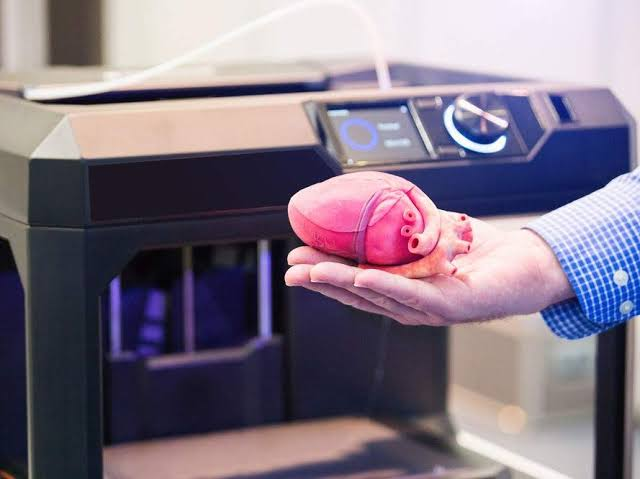
When people think of 3D printing, they may imagine plastic trinkets or the classroom project from their high school engineering class. Meanwhile, the same technology can create medical devices, where patients’ needs are considered. The technology satisfies the definition of cutting edge: the capacity to fuse digital design and manufacturing in novel ways.
The Process of 3D Printing
A 3D-printed medical device does not arrive complete, but as information. The Food and Drug Administration (FDA) states that a 3D-printed design could utilize “predetermined design specifications…or patient-specific anatomic information.” This data is converted into instructions for a 3D printer by specialized software.
“A common 3D printing process is powder-bed fusion, which uses heat to fuse together particles of metal or plastic,” says the FDA . An electron beam or laser heats printing medium, such as titanium or nylon, until desired pieces are formed. The layers of printed material stick together, building a larger whole.
What arrives in the print is more than an idea or impression. Software-informed 3D printers output a tangible example of the inputted design.
From Generic to Specific
Medical 3D-printing can produce generic medical devices, but the technology is no less useful at personalizing patient-specific medical devices. The FDA lists surgical guides, implants, and prosthetics as examples. Design specifications may originate from non-patient-specific resources or “patient-specific computed tomography (CT) scan data.” This process is not dissimilar to many manufacturing fields.
A factory producing thousands of one model of a given item will have procedures to guarantee quality control. But what does it mean to take that same process and apply it to a single item that must fulfill unique standards? The application of 3D-printing processes to patient-specific devices requires careful consideration, calibration, and quality control. The novelty of 3D-printing is not in the printing itself, but in how it can be utilized.
The Role of Printing Beyond the Printer
Finishing a 3D-printed object is not the end of the road. According to the FDA, post-print processing “may include cleaning, polishing, additional machining, or sterilization.” The integrity of the printed material also matters. “In general, FDA evaluates finished devices for specific intended uses…A material that has been approved for one type of device is not automatically
approved for another type of device.” Not every possible use of a given material falls under the same standard.
Printing a new object is exciting, but not every designer should stop at the first product. A designer must consider the intended function of a given 3D-printed device. A new use for a previously-used material may necessitate a return to the drawing board.
Why It Matters
Medical 3D-printing is one example of a larger trend of manufacturing fields becoming more personalized. It is also a field where such individualization matters: devices are built to individual specifications, but must still fulfill the same standards as any other product. The future of 3D-printing in medicine is not in the novelty of the technology, but the fulfillment of individual need. The promise of the technology will be fulfilled when it is made into products that people need and can use.
Sources
- FDA . “ Medical Applications of 3D Printing .” FDA , 2026.
- FDA . “ Process of 3D Printing Medical Devices .” FDA , 2026.