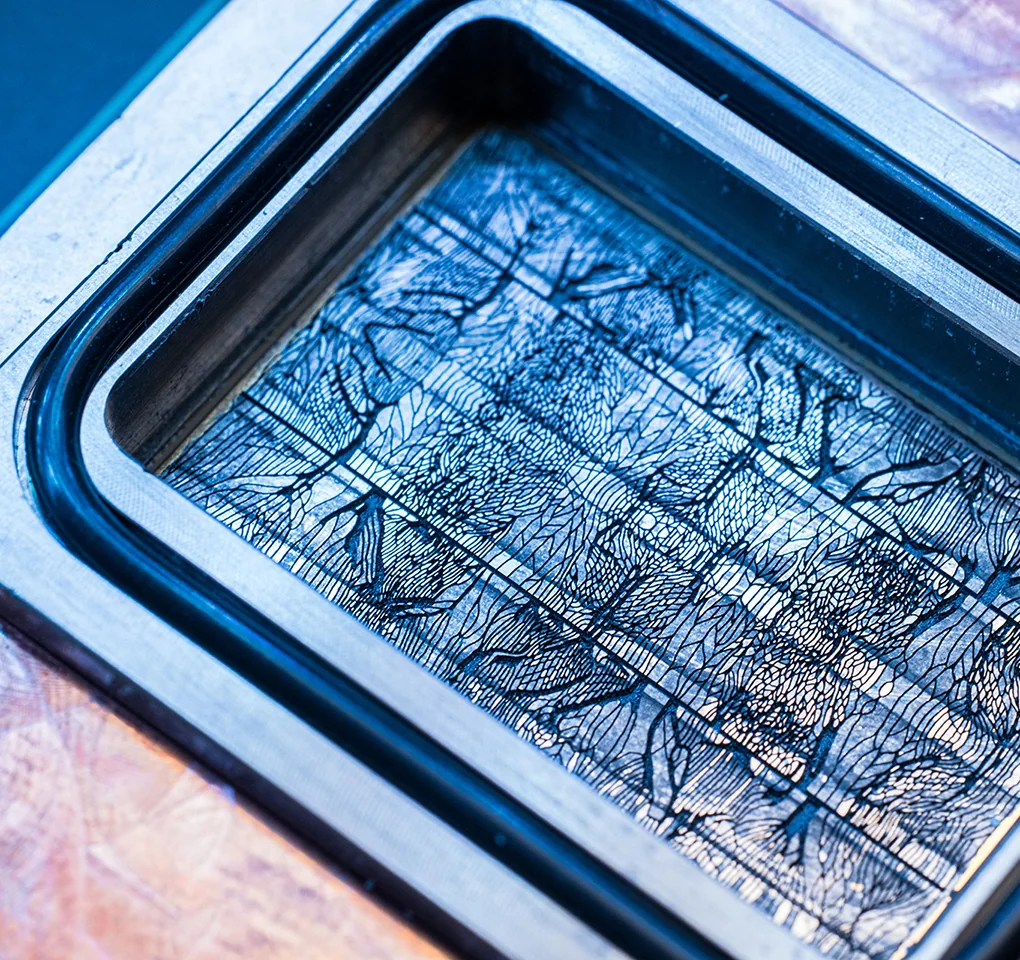
With increasing compute density demands in advanced AI workloads, 3D IC stacking of chiplets has become the dominant methodology to overcome physical limitations of 2D planar chipscale packaging. But placing high-power logic dies directly underneath HBM stacks creates extreme thermal bottlenecks at local power densities exceeding $1,000\text{ W/cm}^2$.
To enable next-generation 3D AI accelerators without catastrophic thermal throttling and package warpage, IMEC and TSMC are developing direct-on-chip 3D stacked micro-fluidic liquid cooling approaches that embed fluidic channels directly into the 3D interposer and silicon dies to remove heat from within the 3D stack.
1. The Thermal Barrier in 3D-Stacked AI Accelerators
Traditional 2D planar packaging utilizes top-side cold plates and passive TIM materials to conduct heat away from the silicon surface. In 3D heterogeneous stacks (TSMC's SoIC stacked atop logic + HBM arrays), this approach is fundamentally incapable of managing conductive/convective heat dissipation:
Vertical Thermal Trapping: High-power logic base dies cannot effectively dissipate heat upwards through stacked memory dies, creating localized thermal hotspots.
TIM Thermal Resistance Limits: Continuous solid conductive paths and copper heat spreaders impose fundamental thermal resistance limits that cannot sustain heat flux densities in excess of $500\text{ W/cm}^2$.
Differential Expansion & Structural Stress: Extreme thermal gradients across heterogenous bonded dies cause mechanical stress, leading to increased defect density, micro-bump voiding, and TSV shear failure.
2. Platform Architecture: Embedded Micro-Fluidic Channels
To eliminate thermal resistance between heat source and coolant, the cooling interface is being integrated inside the 3D package via micro-channel etching and direct jet impingement:
Etched Silicon Micro-Channels: Micro-fluidic channels with sub-100µm dimension are directly etched through silicon functional dies or embedded within intermediate interposer silicon using anisotropic dry etching.
Direct Precursor Contact: Coolant fluids (dielectrics or deionized water) are circulated directly on top of active silicon substrate, eliminating any need for TIM materials.
Interposer Fluid Integration: Micro-fluidic manifolds embedded within the 3D interposer deliver direct jet impingement of targeted cooling fluid on high-power compute die areas to maintain uniform surface temperature across multi-die arrays.
3. Co-Design: Integrating Fluid Dynamics with TSV Interconnects
Integrating fluid channels inside a active 3D silicon stack requires careful co-design of hydraulic flow rates and dense electrical interconnects:
TSV-Compatible Fluid Pathways: Micro-fluidic channels are fabricated in conjunction with high-density Through-Silicon Vias (TSVs) and copper hybrid bonding arrays (sub-2µm pitch) to avoid flow interference with vertical electrical signal paths.
Reduced Pumping Overhead: Manifold architecture utilizing distributed micro-jet arrays minimizes pressure drops across the package, enabling high coolant flow rates with minimal auxiliary pump power consumption.
Targeted Hotspot Mitigation: Computational fluid dynamics (CFD) modeling correlates micro-channel density distribution to runtime power profiles of individual dies to maintain proportional coolant flow to hyper-dense NPU blocks.
4. Foundry Scalability & High-Volume Manufacturing Roadmaps
Adaptation of embedded micro-fluidics from lab prototypes to foundry production requires structural integration within existing 3D stacking methodologies:
Compatibility with Wafer-Level Stacking: Micro-channel etching and fluid port fabrication is integrated with existing wafer-to-wafer (W2W) and die-to-wafer (D2W) hybrid bonding processes using standard CMOS process equipment.
Leak-Free Hermetic Packaging: Advanced metal-to-metal bonding and specialized polymer sealants are employed to provide hermetic isolation between fluid pathways and critical electrical interconnects, preventing dielectric fluid leakage and breakdown over extended operation lifetimes.
Unlocking Ultra-Dense AI Compute: By reducing package thermal resistance up to $3\times$ compared to conventional cold plate solutions, embedded 3D micro-fluidic cooling enables 100kW+ server rack thermal budgets, unlocking multi-terawatt scale utility data center AI accelerators.
Sources
- Bolgar, C. (2025, September 24). Etched microfluidic cooling channels forming intricate tree-like geometric branching networks across a silicon chip surface [Photograph]. Microsoft News. https://news.microsoft.com/source/features/innovation/microfluidics-liquid-cooling-ai-chips/