5G Network Slicing: Different Services on Shared Infrastructure
A phone streaming video and a business sending time-sensitive information use the same basic mobile network, but their needs can be very different. Network slicing gives an operator a way to organize those needs into distinct logical services without constructing a separate physical network for each one.
What is a network slice?
Ericsson describes network slicing as multiple logical networks running on shared physical infrastructure. Each slice can have a configuration suited to a service or user group. One might emphasize throughput, while another emphasizes reliability or short delays. The underlying equipment can still be shared.
A useful analogy is a building with rooms designed for different activities. The rooms have distinct arrangements, but they depend on common foundations and utilities. Likewise, describing a slice as separate does not mean it has unlimited capacity or is independent of every physical problem.
Why the whole path matters
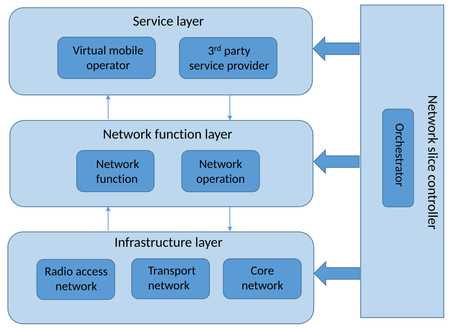
Ericsson’s technical review on end-to-end orchestration explains that slicing involves resources across the radio access network, core, cloud, and transport network. A service’s performance depends on the connections between these parts, not just on a setting near the user’s phone.
This makes coordination important. An operator needs to translate a service requirement into resource allocations and operating rules along its path. The review also explains that the appropriate form of isolation depends on the transport technology. There is no single arrangement that automatically fits every application.
Imagine an exhibition venue offering ordinary visitor connectivity and a separate service for its production team. A proposed slice could define the team’s intended coverage and performance. The venue would still need to ask what is actually reserved, where the service applies, and how it behaves during congestion. This is a hypothetical example of evaluating a contract rather than a claim about a deployed network.
The appeal and the tradeoffs
Slicing can make shared infrastructure more adaptable. It gives service providers a framework for offering different connectivity experiences while managing common equipment. Ericsson notes that 5G Standalone and the 5G Core are important to the technology’s fuller capabilities.
However, labels alone do not establish service quality. A customer should be able to distinguish a preference for certain traffic from a defined performance commitment. The important questions are concrete: what is measured, under what conditions, and what happens when the promised level is missed?
Operators also need to consider how choices for one service affect overall use of scarce resources. Allocating capacity to a particular group can be worthwhile, but the justification should be clear. These management decisions are as important to the user experience as the technical architecture.
Summary
Network slicing organizes a mobile network into logical services with different requirements. Its promise lies in coordinated customization across shared infrastructure. Its success should be judged through measurable performance and clearly explained service boundaries, rather than through the slice label alone.
Works Cited
Ericsson. “Network Slicing – Enabling Differentiated Connectivity.” n.d. Accessed 10 Oct. 2026.
Ericsson. “Transport-Aware End-to-End Network Slicing Orchestration.” n.d. Accessed 10 Oct. 2026.
Xenofon Foukas, Georgios Patounas, Ahmed Elmokashfi, and Mahesh K. Marina. “Generic 5G network slicing framework.” Wikimedia Commons, 2017. Image. Public domain. Accessed 10 Oct. 2026.
A published framework for 5G network slicing. Image: Xenofon Foukas, Georgios Patounas, Ahmed Elmokashfi, and Mahesh K. Marina; Public domain.