Abrasive Waterjet Cutting: Shaping Material by High-Speed Erosion
Water can gradually wear away stone. An abrasive waterjet accelerates that general idea into a controlled manufacturing process. A narrow stream carries abrasive particles that remove material along a programmed path.
Where the cutting action comes from
OMAX distinguishes pure waterjet cutting from abrasive waterjet cutting. A pure jet can cut suitable softer materials. An abrasive jet adds particles, commonly garnet, to help cut harder materials. The particles provide the erosion that removes the workpiece material.
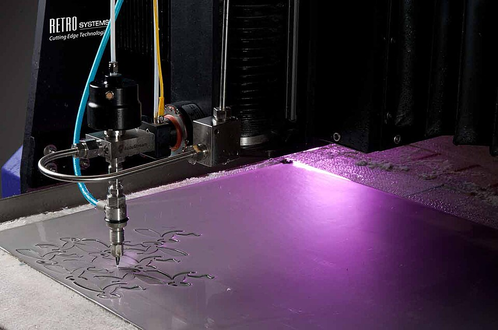
The manufacturer’s nozzle documentation describes high-pressure water passing through an orifice and entering a mixing chamber. Abrasive is drawn into the flow, and a mixing tube forms the cutting stream. This explanation identifies the main components without specifying operating settings for a job.
Why it is considered a cold process
OMAX describes abrasive waterjet cutting as avoiding a heat-affected zone associated with thermal cutting. Material is removed through erosion rather than being melted along the cut. That can be useful when a project wants to avoid changes caused by concentrated heat.
This does not make the process universally suitable or free of constraints. The cut has a width, the stream interacts with the material, and the finished edge depends on the cutting conditions. A drawing still has to be translated into a practical tool path.
An example in a workshop
Imagine a workshop making a flat bracket from a material that is difficult to machine with its existing tools. It could commission sample waterjet cuts and measure the resulting dimensions and edge quality. The test would use the intended material and thickness rather than a convenient substitute.
This hypothetical comparison would include the whole part. A visually smooth straight edge might not establish the quality of small holes, tight corners, or features near one another. The team would also ask what secondary work is necessary before assembly.
Consumables and consistency
OMAX’s discussion of garnet explains that abrasive properties and particle size affect cutting behavior. The abrasive is therefore a process input, not an interchangeable decoration added to the water. Its quality and delivery influence the result.
The company’s FAQs also emphasize that accuracy depends on material, thickness, cutting speed, and other factors. Test cuts provide more useful evidence for a particular part than an unqualified accuracy claim. Slower and faster paths can involve different tradeoffs between production time and edge quality.
A complete cost comparison includes abrasive use, pump operation, nozzle wear, material handling, and management of the used water and cutting residue. These ordinary production questions determine whether the method fits the workshop’s needs.
Summary
Abrasive waterjet cutting uses a controlled stream of water and particles to erode a shape from material. Avoiding thermal cutting effects is an important attraction. Practical value depends on the actual part geometry, cut quality, consumables, and supporting workflow.
Works Cited
OMAX. “OMAX Waterjet FAQs.” n.d. Accessed 10 Oct. 2026.
OMAX. “Abrasive Waterjet Nozzle.” n.d. Accessed 10 Oct. 2026.
OMAX. “The Gem That Makes the Cut: Garnet’s Role in Abrasive Waterjet.” 29 Mar. 2021. Accessed 10 Oct. 2026.
Steve Brown Photography. “Retro Systems Waterjet.” Wikimedia Commons, 16 April 2013. Image. CC BY 3.0. Accessed 10 Oct. 2026.
A CNC waterjet cutting machine. Image: Steve Brown Photography; CC BY 3.0.