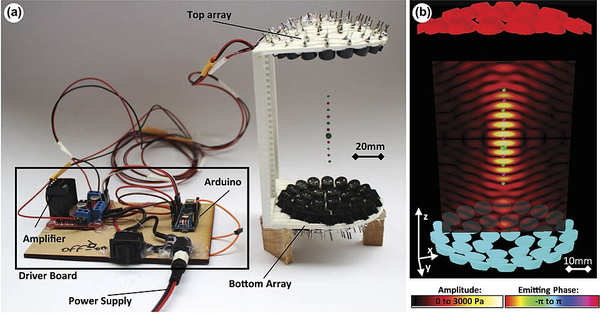
A droplet hanging in midair can look like a trick. In acoustic levitation, a carefully arranged sound field supplies forces that can support a small sample. The technique is interesting because the sample can be studied without resting against the walls of a container.
How sound provides support
An Argonne Advanced Photon Source seminar describes stable droplet levitation at nodes of a standing sound wave, with acoustic radiation forces balanced against other forces, including gravity. The sound field is deliberately arranged; ordinary conversation does not suspend objects around a room.
ETH Zurich research likewise describes using a standing wave to generate forces that counter gravity for small particles. The sample’s size, shape, and material influence its behavior. Position and orientation can require additional control.
A standing wave forms a spatial pattern rather than simply traveling away from its source. That pattern supplies locations where a suitable sample can be trapped. The device must maintain the acoustic conditions needed for the trap.
Why avoid a container?
Argonne’s research report explains that contact-free sample handling can reduce contamination or unwanted events at a solution–container interface. That can be useful when the container itself would complicate a measurement. Acoustic trapping offers a way to change the sample environment.
Imagine a laboratory comparing how a small droplet changes during drying. A levitation arrangement might permit observation without a supporting dish underneath it. The team would still need to compare conditions and determine whether the acoustic field changes the behavior being measured. This is a hypothetical research example, not a demonstration result.
Levitation can affect the sample
The Argonne seminar discusses droplet motion and evaporation, including the difference between a stable sample and one that jitters. This is a reminder that removing physical contact does not remove every influence from the measuring system.
A researcher needs to document the sample’s motion, the surrounding conditions, and the sound field. If the aim is to understand a material process, the holding method should be
assessed as part of that process. Otherwise, an observed effect might be attributed to the material when it partly reflects the levitation environment.
Benefits and boundaries
The technique can provide a useful contact-free environment for small samples. It is not a general replacement for shelves, containers, or large-scale material handling. Suitable forces and stable control have to be achieved for the actual object.
A useful experiment begins with a specific reason to avoid contact and a clear measurement goal. Researchers can then decide whether acoustic support improves the experiment and whether its effects can be characterized adequately.
Summary
Acoustic levitation uses structured sound fields to support suitable small samples. Its value lies in contact-free handling and measurement. The most convincing applications also account for motion, evaporation, and the influence of the sound field itself.
Works Cited
Suthar, Kamlesh. Argonne Advanced Photon Source. “Acoustically Levitated Liquid Droplet.” 22 Mar. 2017. Accessed 10 Oct. 2026.
ETH Zurich Research Collection. “Multi-Frequency Acoustic Levitation and Trapping of Particles in All Degrees of Freedom.” n.d. Accessed 10 Oct. 2026.
Argonne National Laboratory. “Laboratory Directed Research and Development Program Activities – FY 2017 Annual Report.” 2018. Accessed 10 Oct. 2026.
Asier Marzo, Adrian Barnes and Bruce W. Drinkwater. “TinyLev Acoustic Levitator Diagram.” Wikimedia Commons, 10 August 2017. Image. CC BY 4.0. Accessed 10 Oct. 2026.
A TinyLev acoustic levitator and a simulation of its pressure field. Image: Asier Marzo, Adrian Barnes and Bruce W. Drinkwater; CC BY 4.0.