Adaptive Traffic Signals: Updating Timing as Demand Changes
Traffic can change faster than a fixed timetable anticipates. A signal plan that works on an ordinary morning may be less useful during an event or an unexpected disruption. Adaptive signal control uses measurements of current conditions to update how signal time is allocated.
The feedback loop
The Federal Highway Administration describes a cycle of collecting traffic data, evaluating conditions, and implementing timing changes. The process repeats as demand changes. Sensors, communications, controllers, and the control strategy form a connected system.
The useful distinction is responsiveness to a defined operating objective. FHWA’s validation guidance describes adaptive systems as evaluating performance against one or more objectives and updating timing accordingly. The objective might concern smooth flow, queues, throughput, or access among competing movements.
More than extending one green light
An intersection is part of a network. Improving one movement can affect another intersection or a side street. The system needs a clear idea of what it is trying to improve, rather than treating all traffic as one undifferentiated stream.
Imagine a corridor that experiences changing demand around a sports venue. An adaptive system might help adjust to those variations. A project team would still need to assess side streets, crossing needs, and the corridor’s available capacity. This is a hypothetical use case, not a guaranteed performance result.
The team could define success before installation: for example, a specified measure of travel-time reliability while maintaining acceptable service elsewhere. That makes it easier to judge whether the system delivers the intended benefit.
A fair before-and-after comparison
FHWA’s guidance identifies baseline timing as a major source of uncertainty in evaluating benefits. Replacing badly outdated timing can produce a large improvement, but that does not show the same advantage over a well-maintained conventional plan.
A useful study should describe both arrangements, the demand conditions, and the measures used. It should examine more than a short favorable period. If a headline percentage omits the starting conditions, readers cannot tell what the change actually demonstrates.
Maintenance and limits
FHWA notes that adaptive systems involve detection and communication requirements that can make them more complex to operate. Reliable input data is essential. If a sensor fails or measurements become misleading, the control system needs an appropriate response.
Adaptive timing also cannot create unlimited road capacity. It is a way to manage available signal time and respond to variation. Its value should be considered alongside the network’s physical constraints and the travel needs the authority has chosen to serve.
Summary
Adaptive traffic signals use repeated measurement and adjustment to respond to changing demand. Their effectiveness depends on clear objectives, dependable detection, and a fair comparison with existing operation. The best evidence shows how the system improves the chosen outcomes across representative conditions.
Works Cited
Federal Highway Administration. “Adaptive Signal Control Technology.” n.d. Accessed 10 Oct. 2026.
Federal Highway Administration. “Measures of Effectiveness and Validation Guidance for Adaptive Signal Control Technologies: Chapter 1.” n.d. Accessed 10 Oct. 2026.
Federal Highway Administration. “Measures of Effectiveness and Validation Guidance for Adaptive Signal Control Technologies: Chapter 3.” n.d. Accessed 10 Oct. 2026.
Millertime83. “Detection camera and radio on a traffic signal mast arm.” Wikimedia Commons, 10 June 2013. Image. CC BY-SA 3.0. Accessed 10 Oct. 2026.
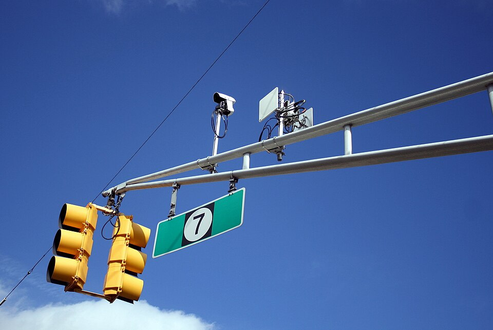
Detection camera and radio equipment for adaptive traffic signals. Image: Millertime83; CC BY-SA 3.0.