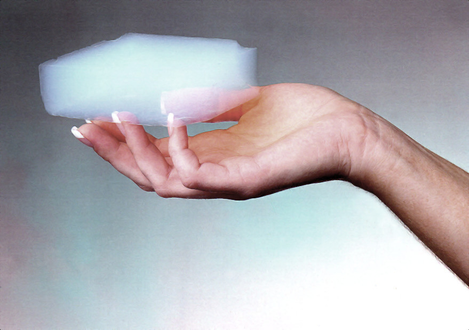
An aerogel can look like a pale, almost weightless piece of solid smoke. Its unusual appearance comes from a solid framework surrounding a great deal of empty space. That structure makes aerogels interesting when engineers want insulation without much thickness or mass.
What is an aerogel?
NASA explains that an aerogel can be made by forming a gel and removing its liquid while preserving the solid structure. The result is a porous material. Silica is a familiar starting material, but aerogels can also be made with other chemistries, including polymers.
The removal process is important because simply allowing a wet gel to collapse would produce a different structure. Preserving a fine network of pores helps retain the properties that make an aerogel useful. The word describes a material family rather than one universal product.
Why pores help with insulation
NASA’s discussion of aerogels connects their insulating performance with nanoscale pores and reduced heat transfer through the gas inside them. A small amount of solid material supports a large volume of porous space. This can make the material light as well as thermally useful.
However, an insulation product is more than an ideal pore network. It needs to be handled, installed, and used under actual conditions. NASA notes that traditional silica aerogels can be fragile, which has encouraged reinforced and composite forms.
From a delicate sample to a usable product
NASA Spinoff describes aerogel-infused blankets and other composite insulation approaches. Combining aerogel with supporting material can make it easier to incorporate into practical equipment. The surrounding material becomes part of the product’s mechanical behavior.
Imagine a designer comparing insulation options for a compact equipment housing. A thin aerogel-based layer might help where space is limited. The designer would still need to evaluate the complete assembly: seams, supports, exposed edges, and the way the layer is compressed during installation. This example is hypothetical and does not specify a particular commercial product.
The most meaningful comparison would measure heat flow through the finished housing, not only through a small material sample. A useful material property can be weakened by gaps or other paths through which heat travels.
Benefits and limits
Aerogels can offer a combination of low mass and insulation performance. But strength, flexibility, temperature capability, moisture behavior, and cost depend on the formulation and product. The properties of one silica sample should not automatically be assigned to a polymer aerogel or a composite blanket.
A project team should ask what has actually been measured and under what conditions. It should also consider whether the product remains effective after handling and use. The best choice is the one that meets the application’s full set of requirements, not necessarily the sample that looks lightest.
Summary
Aerogels use a preserved porous framework to limit heat transfer while keeping mass low. Their practical value comes from turning that structure into a durable, appropriate insulation product. Chemistry, reinforcement, and the design of the finished assembly all matter.
Works Cited
NASA. “Aerogels: Thinner, Lighter, Stronger.” n.d. Accessed 10 Oct. 2026.
NASA Spinoff. “Aerogels Insulate Against Extreme Temperatures.” 2010. Accessed 10 Oct. 2026.
NASA Spinoff. “Aerogel Insulation Makes Thinner, Warmer Outerwear.” 2018. Accessed 10 Oct. 2026.
NASA/JPL-Caltech. “Aerogel hand.” Wikimedia Commons, between 1994 and 1999. Image. Public domain. Accessed 10 Oct. 2026.
A piece of aerogel held in a hand. Image: NASA/JPL-Caltech; Public domain.