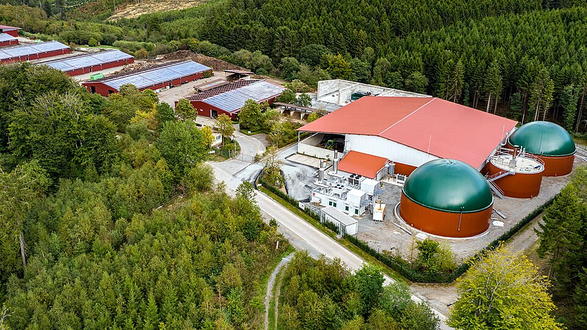
Anaerobic Digesters: Recovering Energy from Organic Waste
Food scraps and manure contain material that microorganisms can break down. In an anaerobic digester, that process happens without oxygen inside an engineered system. The result can include useful gas and a residual material that still needs careful management.
What happens inside a digester?
The U.S. Environmental Protection Agency explains that anaerobic digestion uses microorganisms to break down organic matter in an oxygen-free environment. Suitable feedstocks include food waste, manure, and wastewater solids. Some systems combine several feedstocks, a practice called co-digestion.
The reactor provides a controlled environment for the microbial community. EPA’s AgSTAR explanation notes that reactors are designed for their site and feedstock conditions. A digester is therefore both a biological process and a piece of engineered infrastructure.
Two important outputs
EPA identifies biogas and digestate as the main outputs. Biogas is composed largely of methane and carbon dioxide, with other constituents present in smaller amounts. It can be used for energy, but cleaning or upgrading may be necessary for the intended equipment or fuel use.
Digestate is the remaining mixture of solids and liquids. It can have useful applications after appropriate treatment and handling. The existence of a residual product is important: digestion does not make all incoming material disappear, and managing that product is part of the project.
An illustrative local project
Imagine a food-processing site considering a digester for a consistent organic waste stream. The planning team could start by measuring the material available, its variation through the year, and whether contamination is a problem. It would then compare possible uses for the gas and a realistic destination for the digestate.
This hypothetical project would need more than a promising estimate of gas production. A complete assessment would include collection, preprocessing, reactor operation, gas handling, and the equipment that uses the energy. A useful output that has no dependable recipient may add a management burden instead of solving one.
Operation matters as much as construction
EPA’s operator guidebook addresses process control, testing, mechanical systems, gas handling, maintenance, and safety. Its scope shows why a digester requires sustained attention. Biological conversion has to remain stable, and equipment has to continue functioning around it.
Environmental claims should also be evaluated across the whole process. It is reasonable to ask how gas is captured, how leakage is monitored, and how residual materials are managed. The relevant comparison includes the waste-management method being replaced and the actual use of the recovered energy.
Summary
Anaerobic digesters use controlled microbial activity to convert suitable organic material into biogas and digestate. Their value depends on reliable feedstocks, stable operation, and useful destinations for both outputs. They are most understandable as complete waste-and-energy systems rather than tanks that simply turn scraps into fuel.
Works Cited
U.S. Environmental Protection Agency. “Basic Information about Anaerobic Digestion.” n.d. Accessed 10 Oct. 2026.
U.S. Environmental Protection Agency, AgSTAR. “How Does Anaerobic Digestion Work?.” n.d. Accessed 10 Oct. 2026.
U.S. Environmental Protection Agency, AgSTAR. “Anaerobic Digester/Biogas System Operator Guidebook.” Nov. 2020. Accessed 10 Oct. 2026.
Thzorro77. “Biogasanlage mit Kompostierung.” Wikimedia Commons, 27 October 2020. Image. CC BY-SA 4.0. Accessed 10 Oct. 2026.
An anaerobic digestion and composting facility in Germany. Image: Thzorro77; CC BY-SA 4.0.