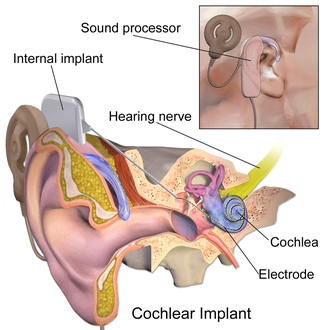
Cochlear Implants: Converting Sound into Electrical Stimulation
A cochlear implant connects a sound-processing system with an implanted electrode arrangement. Its aim is to provide useful sound information through electrical stimulation. Understanding the signal path helps explain why it differs from simply making incoming sound louder.
The external and internal components
The FDA describes an external microphone, sound processor, and transmitter, together with an implanted receiver and electrode system. The microphone gathers environmental sound. The processor converts that input into information the implanted system can use.
NIDCD explains that a transmitter and receiver/stimulator turn the processed information into electrical impulses. An electrode array delivers stimulation within the cochlea, engaging the auditory pathway. The complete system connects acoustic input with a different form of neural input.
Why processing is essential
The implant cannot simply pass every detail of the acoustic waveform directly to the auditory system in its original form. Its processor selects and arranges sound information for the stimulation system. This makes the conversion strategy an important part of the technology.
NIDCD distinguishes cochlear implants from hearing aids: hearing aids amplify sound, while implants bypass damaged portions of the ear and stimulate the auditory nerve. It also states that an implant does not restore normal hearing. The representation can be useful, but learning to interpret it takes time.
A hypothetical engineering comparison
Imagine researchers comparing two processing approaches in a controlled study. They would need to define the listening task, the test conditions, and the outcomes being measured. A change that improves one task might not establish an improvement for every environment or user.
This example concerns evaluation of technology rather than selection of a treatment. Device suitability and individual care involve clinical decisions that cannot be inferred from a general explanation of the electronics.
The research team would also need to separate several kinds of result. Detecting that a sound occurred, recognizing an environmental signal, and understanding speech are different outcomes. A clear report should state which outcome changed instead of using the broad word “hearing” for everything.
The whole experience matters
An implant’s useful function involves external hardware, the implanted system, configuration, and the user’s developing interpretation of signals. The device is not a complete explanation of the listening experience on its own.
For technology reporting, this means performance should be described with context. The acoustic setting, task, and participant group matter. A successful result in a controlled condition should not be generalized into an identical experience for every person.
Summary
Cochlear implants transform microphone input into processed signals and electrical stimulation of the auditory pathway. The technology can provide useful sound information, but its representation differs from normal hearing. Understanding both the signal-processing chain and the user’s adaptation gives a more accurate account of its capabilities.
Works Cited
U.S. Food and Drug Administration. “What Is a Cochlear Implant?.” n.d. Accessed 10 Oct. 2026.
National Institute on Deafness and Other Communication Disorders. “Cochlear Implants.” n.d. Accessed 10 Oct. 2026.
National Institute on Deafness and Other Communication Disorders. “Cochlear Implants: NIDCD Fact Sheet.” 2024. Accessed 10 Oct. 2026.
BruceBlaus / Blausen.com staff. “Blausen 0244 CochlearImplant 01.” Wikimedia Commons, 15 October 2013. Image. CC BY 3.0. Accessed 10 Oct. 2026.
Published illustration of cochlear implant components. Image: BruceBlaus / Blausen.com staff; CC BY 3.0.