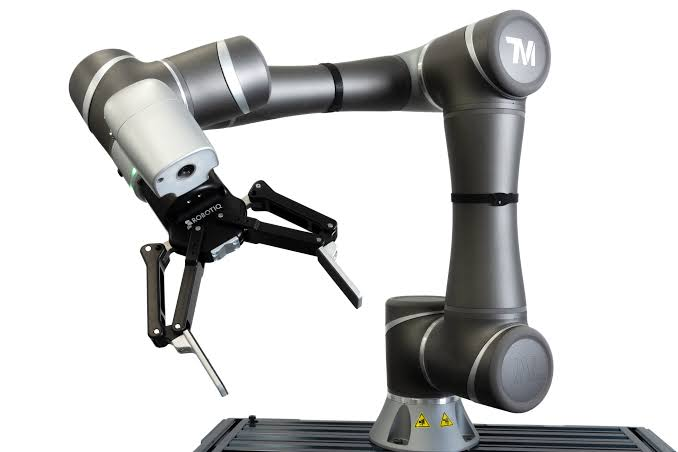
A factory robot does not need to complete all aspects of a job in order to be useful. Sometimes, its value lies in completing a single, repetitive task while the rest of the process is done by humans. Collaborative robots (cobots) are specifically designed for applications that make use of robotic assistance in human work environments.
What Do Cobots Do?
The examples given by Universal Robots include assembly, machine tending, packaging, inspection, and polishing as possible applications of a collaborative robot arm. Variations of these utilize different tools and configurations.
The robot thus takes on a role in a bigger application, and its effectiveness depends on the tasks given to it and its ability to fit in with the processes undertaken by humans.
Why Dividing Tasks Matters
Suppose one is looking at a small workshop where human employees are constantly inserting parts into a machine. Perhaps there is potential for a robot to take over this part of the process while the humans move on to other steps, such as inspecting the product and organizing production.
This hypothetical scenario demonstrates the process by which an application for a robot should be considered. One has to look at what tasks make up a process and determine which of them can be reliably fulfilled by a machine.
A machine that completes one single action in a consistent manner may sometimes be preferable to a complex automation that is not designed to deal with specific, varied tasks. The context in which a robot is used is important to its overall effectiveness, even if the manipulator itself is simple.
### Planning The Complete Application
The word collaborative should not be used as a justification for automating any process without further consideration. After all, a robot that simply moves small objects is not the same physical or technical environment as one that manipulates a sharp object.
Before implementing a robot in a workplace environment, one has to consider human interaction with the technology, the training necessary to utilize it, and ways in which it cannot be utilized.
These considerations also define automation’s potential effectiveness. Employees must know how to operate and supervise a robot in order to make the technology useful.
A demo of a robot moving an object is therefore only one element of a bigger application.
Conclusion
Collaborative robotics promote the reconsideration of how tasks are divided between humans and machines. The most effective applications have well-defined roles and utilize reliable, consistent operations, planning, and execution. A cogent application for a cobot should be concerned with making the entire process more efficient than it would be without the technology.