DAB Digital Radio: Several Programs in One Broadcast
A radio dial traditionally suggests one station at one frequency. Digital Audio Broadcasting, or DAB, organizes things differently. It can combine several services into a shared transmission and let a receiver select the one a listener wants.
What is a multiplex?
WorldDAB’s glossary describes a multiplex as a combined data stream shared by radio and data services. The individual streams are transmitted in alternating chunks. A listener still chooses a station, but the receiver extracts that service from the common transmission.
This arrangement creates a different planning problem for broadcasters. The shared transmission has a finite capacity. How that capacity is divided among services affects the space available for each program and its associated information. Adding another service therefore involves more than simply adding a name to a menu.
How the broadcast reaches listeners
ETSI’s DAB standard describes a system that combines program streams and uses many carriers through Orthogonal Frequency Division Multiplexing, or OFDM. It also distributes transmitted information in ways intended to help the receiver cope with channel disturbances and reflected signals.
An important network feature is the single-frequency network. WorldDAB explains that synchronized transmitters can carry the same multiplex on the same frequency across an area. This can simplify frequency reuse, but the transmitters must be planned and coordinated. Their signals cannot simply be placed anywhere without regard to timing and geography.
Imagine a regional broadcaster carrying news, music, and a language service in one multiplex. A compatible receiver could display those choices while receiving the same shared radio channel. The operator’s job would include allocating capacity, maintaining the distribution links, and ensuring coverage where listeners actually travel. This is an illustrative example, not a report about a specific broadcaster.
Digital does not mean unlimited
DAB is a broadcast system rather than an individual internet connection for each listener. That distinction is useful when thinking about distribution: people within coverage can receive the same transmission without each requesting a separate stream from a server.
However, the experience still depends on the network and receiver. Terrain, buildings, antenna arrangements, and the choice of transmission parameters can affect reception. A digital label should not be treated as proof that every indoor location will have satisfactory coverage.
DAB and DAB+ also need to be distinguished when evaluating compatibility. WorldDAB’s implementation guidance addresses DAB+ systems, while older equipment may have different capabilities. For a broadcaster, a meaningful transition plan includes the listening devices people already own, not only the transmitting equipment.
Summary
DAB combines multiple services into a shared digital broadcast. Its multiplex and coordinated transmitter network can use spectrum in a flexible way. Good outcomes depend on thoughtful capacity allocation, receiver compatibility, and coverage planning that reflects real listening conditions.
Works Cited
WorldDAB. “Glossary.” n.d. Accessed 10 Oct. 2026.
ETSI. “EN 300 401 V2.1.1: Digital Audio Broadcasting to Mobile, Portable and Fixed Receivers.” n.d. Accessed 10 Oct. 2026.
WorldDAB. “Establishing DAB+ Digital Broadcast Radio, 2nd Edition.” 2025. Accessed 10 Oct. 2026.
Håvard Wien. “DAB Radio 07.” Wikimedia Commons, 2 September 2016. Image. CC BY-SA 4.0. Accessed 10 Oct. 2026.
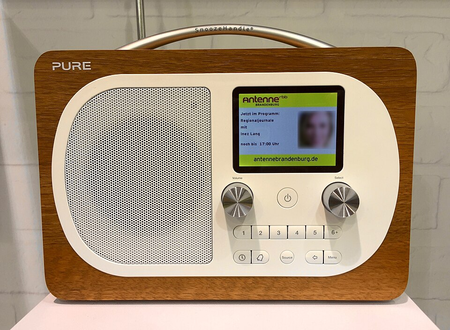
A Pure DAB radio receiver. Image: Håvard Wien; CC BY-SA 4.0.