Database Transactions: Keeping Related Changes Together
What happens if a program finishes half of an update and then stops? A database might contain one change without another change that was supposed to accompany it. Transactions address this problem by grouping operations into a defined unit of work. They are one reason a dependable digital service needs more than a collection of tables that can be edited quickly.
An All-or-Nothing Operation
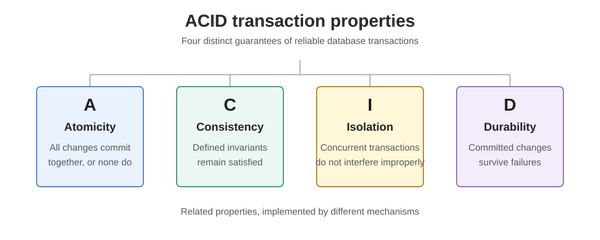
PostgreSQL's tutorial explains that a transaction bundles several steps into an all-or-nothing operation. The group either completes or its changes are canceled. The tutorial also describes committing a completed transaction and rolling back one that should not be kept.
Imagine a school lending system that records an equipment checkout. It must associate a device with a borrower and update its availability. If only the availability changes, staff may know the device is unavailable without knowing who has it. If only the borrower record changes, another person might still see it as available.
That hypothetical example shows why the boundary matters. A developer must identify the changes that belong together. The database cannot decide the meaning of the school’s checkout process merely because it supports transactions.
Several Users at Once
Database systems also have to handle operations occurring at the same time. PostgreSQL's transaction-isolation documentation describes different isolation levels, which determine what a transaction can observe and what kinds of concurrent behavior are permitted.
At the strongest level discussed there, serializable execution aims for a result consistent with transactions having run one at a time. PostgreSQL notes that an application may need to retry a transaction when concurrent activity causes a serialization failure. Stronger coordination can therefore require the application to do additional work.
Returning to the lending example, two students might request the same last available device. The useful result is not simply that both requests are processed quickly. The system must enforce the rule about who can receive the device and respond appropriately to the other request.
Correctness Includes the Rules
Transactions can preserve a group of changes, but the group itself must be designed correctly. If the program records the wrong borrower in a completed transaction, keeping all of its changes together does not make that information accurate.
A team should therefore consider two kinds of testing. One asks what happens when the process is interrupted. The other asks whether simultaneous requests obey the intended rules. Both are relevant to the user who expects an equipment record to mean what it says.
This is a useful lesson beyond databases: a reliable mechanism still needs a clear definition of a successful outcome.
Summary
Database transactions keep related updates together and help organize what concurrent users can observe. Their practical value depends on choosing the right transaction boundaries, enforcing application rules, and handling retries or failures. The result should be a coherent record of an event, even when several people act at once or a process stops unexpectedly.
Works Cited
PostgreSQL Global Development Group. “Transactions.” n.d. Accessed 10 Oct. 2026.
PostgreSQL Global Development Group. “Transaction Isolation.” n.d. Accessed 10 Oct. 2026.
FeedMeGrapes. “Acid transaction properties.” Wikimedia Commons, 5 September 2026. Image. CC BY-SA 4.0. Accessed 10 Oct. 2026.
The four ACID properties of database transactions. Image: FeedMeGrapes; CC BY-SA 4.0.