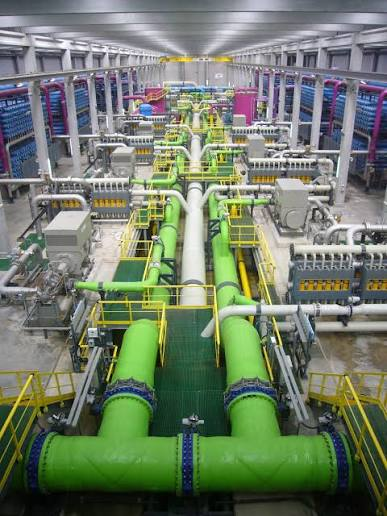
Converting salty water into fresh water seems like a simple process. However, desalination involves a number of factors, including the equipment used, the energy needed to make the process work, and what to do with the byproduct of salt. Becoming aware of these factors provides insight into the technology of desalination.
The text describes two general approaches to desalination: membrane and thermal. In membrane desalination, water is forced through a permeable membrane that allows water molecules to pass but keeps dissolved salts out. Membrane desalination using reverse osmosis, according to the Department of Energy,
uses high-pressure pumps to push water through a semipermeable membrane.
Thermal desalination, on the other hand,
involves evaporating water and then condensing the steam to separate pure water from the salt.
The text indicates that thermal desalination is generally less energy efficient than reverse osmosis. On the other hand, thermal processes may be necessary to meet specialized needs.
The text indicates that reverse osmosis is less energy efficient than thermal distillation, but it
requires higher pressures to push water through the membrane, especially with saltier water. It also requires that the membrane material be able to withstand those pressures. One result of the process is brine, a highly concentrated salt solution. When considering reverse osmosis as a process for obtaining fresh water, a community would need to consider the energy required for the process, the costs of producing the brine, and the amount of water that the process could supply.
In summary, desalination can be a viable process for obtaining fresh water, but the viability depends on the particular process and the application. Advancements in technology can improve the process, and careful consideration is necessary when selecting a process to meet a particular need, such as fresh water for a community.