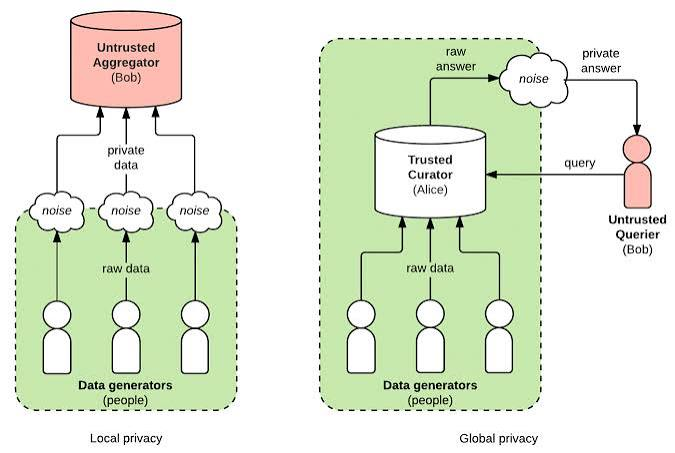
A survey can be taken and provide helpful information about a community without giving away answers from the individuals who took it. The challenge is sometimes about finding ways to share the beneficial statistics while keeping personal details safe. The concept of differential privacy is a mathematical approach to the process, limiting potential information about the participants.
Overview: Privacy in Mathematics
NIST explains that differential privacy can be defined as a method which provides a mathematical description for privacy. An implementation of the technology usually utilizes “the addition of noise to query results,” notes the organization. This is done in order to limit the information about any one individual contained in the results of a query.
“The key is that the addition of noise to protect individual privacy is done in a controlled way,” explains NIST. Failure to do so, notes the organization, can result in reduced effectiveness or reduced utility.
Application in Practice
When a school asks their students how much time they spend on studying on a regular basis, they might be interested in analyzing the data.
A differential privacy might allow for the publishing of a statistic which contains a noisy value. In the hypothetical example, the school’s goal would be analysis which supports the understanding of the target audience while obscuring the details about any one participant.
As such, the example demonstrates how more specific data can provide more benefits for an analysis but also contains more information about the people who provided it.
The Value of Understanding the Risks
In March 2025, NIST issued final guidelines which were meant to help companies in assessing differential privacy practices. The organization was focusing on the practice’s ability to limit disclosure of information. According to NIST, there is value in understanding how the practice can be utilized, “what it can and cannot protect” and “the trade-offs between them.”
In practice, the organization is useful for businesses which are currently analyzing a great amount of data. The label “private” is not enough, as there is no explanation of the technology which protected the information.
Individuals, shareholders and others need to know what the analysis is protecting information from in order to determine if it is valuable for the projected outcome.