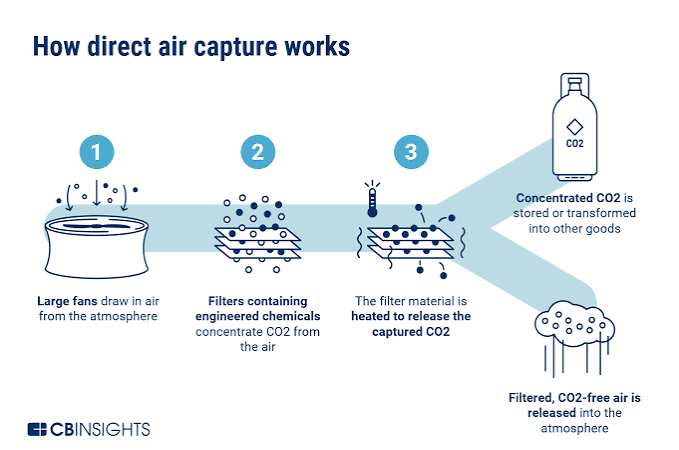
There are two broad categories of climate tech, each of which deals with greenhouse gas emissions differently. Some seek to prevent them from appearing in the atmosphere in the first place, but the direct air capture falls under the second group of technologies, which actively seeks to remove already emitted carbon dioxide.
How Does Direct Air Capture Work?
According to the Department of Energy, this term covers two broad techniques for extracting the gas from the air, which use either liquid or solid components that will bind the carbon dioxide. After that, heat, vacuum, or a combination of the two is used to separate and obtain a concentrated stream of CO ₂.
It is further used to either store it within geologic formations or to create products from it, thus completing the cycle.
Why Energy and Cost Matters
According to the Department of Energy, both energy-intensive processes and costs are among the main problems associated with these technologies.
The fact that carbon dioxide comprises only a small part of the air indicates that extra steps must be taken to separate pure CO ₂.
This, along with the processes of further utilization or sequestration, dictates the overall expenses involved. In the given example, the choice between two similar projects based solely on the capacity numbers would be deceptive, since the energy requirements and stability of long-term storage are not accounted for.
What Are the Right Questions to Ask?
In addition to learning about the energy intensity of the separation process, it is necessary to ask about the overall amount of carbon removed per year and how long it will remain isolated from the atmosphere.
These questions address the very purpose of such technology, which implies a difference between an engineering process involving a particular machine and the outcome intended for society. Before scaling up any climate technology, there must be sufficient evidence that its developers can produce the advertised results at a commercial level. This would require additional proof that the source of power for such technology will be available in adequate amounts.
Conclusion
The technology known as direct air capturing may assist in removing carbon dioxide from the atmosphere, but it involves several engineering problems regarding costs and utilization. However, more research is required to analyze the technology’s practical application, beginning with the overall amount of removed carbon.