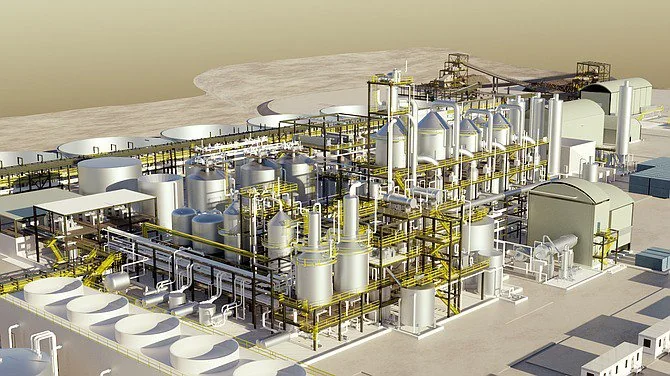
As EV manufacturing accelerates, traditional lithium extraction methods—such as month solar evaporation ponds and energy-intensive hard-rock mining—fail to meet rapidly expanding global supply timelines. Evaporation ponds lose millions of gallons of water in hyper-arid regions, recover only $40\%\text{--}60\%$ of available lithium, and cannot efficiently process brines with high magnesium-to-lithium () ratios.
To bridge this supply deficit, chemical engineers are deploying Direct Lithium Extraction (DLE) via Engineered Membranes. By leveraging sub-nanometer ionic sieve channels, metal-organic frameworks (MOFs), and electrodialysis, membrane-based DLE extracts up to $90\%\text{--}95\%$ of dissolved lithium in hours while drastically reducing freshwater consumption and footprint.
1. Extraction Challenges with Mono-Valent Lithium from Continental & Geothermal Brines
Extracting mono-valent lithium ions () directly from complex natural brines via conventional separation methods introduces severe chemical separation challenges:
Similar Hydration Radius: Magnesium () and lithium () possess nearly identical hydrated ionic radii ( for vs. for ), making physical size-based filtration in conventional nanofiltration membranes inefficient.
Extreme Solute Background Interference: Unrefined continental and geothermal brines contain enormous quantities of sodium (), potassium (), calcium (), and sulfate (), which compete for pore space in conventional membranes and cause severe osmotic backpressures.
Surface Fouling: High temperatures, silica precipitation, and organic fouling in deep geothermal or oilfield-produced waters degrade polymeric membranes, significantly reducing permeation flux and operational lifespan.
2. Nanofluidic & Ionic Sieve Membrane Architecture
DLE membranes exploit sub-nanometer channel transport to enable extreme charge- and size-selective ion transport:
MOF Nanochannels: Incorporating metal-organic framework (MOF) structures (such as ZIF-8 or UiO-66) into thin-film nanocomposite (TFN) membranes forms sub-nanometer windows at the surface that strip the hydration shell from ions, enabling dehydration-assisted transport while physically blocking divalent and ions.
Crown Ether & Cation-Sieve Functionalization: Grafting lithium-selective crown ethers or supramolecular ionophores directly onto polyamide active membranes enables selective binding of , accelerating transport across the active layer via facilitated hopping between sites.
Graphene Oxide & MXene Laminates: 2D material membranes with tunable interlayer spacing () allow high-flux mono-valent ion permeation while exerting strong electrostatic repulsion (Donnan exclusion) against multivalent background cations.
3. Advanced Electrodialysis & Osmotic Energy-Efficient Processes
To concentrate into battery-grade eluates without thermal evaporation, engineered membranes are integrated into continuous electrochemical and pressure-driven cascades:
Lithium-Selective Electrodialysis (LSED): Alternating lithium-selective cation exchange membranes (LSCEMs) and anion exchange membranes under an applied voltage drives migration against concentration gradients to yield high-purity lithium chloride () streams.
Bipolar Membrane Electrodialysis (BMED): Bipolar membranes dissociate water molecules () directly at the membrane surface to convert purified subsea or continental eluates directly into battery-grade lithium hydroxide () without requiring chemical reagents.
Low-Power High-Pressure Nanofiltration (NF): Multistage NF arrays operated at high pressures () can perform initial pre-concentration and separations before downstream polishing to reduce overall energy draw per metric ton of lithium carbonate equivalent (LCE).
4. Industrial Scaling, Environmental Impact & Geothermal Integration
Membrane-based DLE will revolutionize the economics and environmental footprint of global lithium production:
Re-injection & Water Saving: As membrane separations operate continuously in a closed loop without chemical precipitation reagents, up to $>90\%$ of processed brine can be directly re-injected back into deep aquifers, preventing land subsidence and preserving surface ecosystems.
Unlocking Non-Traditional Resources: High-selectivity engineered membranes allow economic lithium extraction from previously unviable low-grade continental brines, geothermal energy fluids, and oilfield-produced water (smackover brines).
Direct Integration with Geothermal Power: In geothermal brine extraction, direct thermal energy harvesting from high-temperature fluids ($100^\circ\text{C}\text{--}180^\circ\text{C}$) can power pressure pumps and electrodialysis stacks to create a carbon-neutral battery raw material refinery.
Sources
- Dragonfly Energy. (2026, April 14). 3D architectural rendering of an industrial direct lithium extraction (DLE) processing facility [Digital artwork]. Dragonfly Energy. https://dragonflyenergy.com/direct-lithium-extraction-elon-musk-and-other-tech-giants-chime-in-on-its-importance/