DNA Data Storage: Archiving Digital Files in Molecules
Could a digital archive be stored in manufactured molecules instead of disks or tape? DNA data storage encodes information using the sequence of DNA bases. It is an archival research approach that connects computing with synthesis and sequencing technology.
From bits to bases
Microsoft Research describes work with the University of Washington on using synthetic DNA as a dense, durable storage medium. A computer first converts digital information into a planned sequence built from the base symbols A, C, G, and T. The sequence is then manufactured as DNA.
Reading reverses the path. The stored material is sampled and sequenced, and software interprets the resulting base information to reconstruct the file. Encoding, synthesis, handling, sequencing, and decoding are all parts of the storage system.
This use of DNA does not require a file to become a trait in a living organism. The cited archival work uses manufactured DNA as an information medium. It should be understood as a storage process, not as a method for changing a person’s biology.
Why an archive is the target
Microsoft’s project page identifies density and durability as attractions, while also recognizing synthesis and sequencing as practical constraints. Those characteristics suggest a role for information that can wait through a comparatively involved retrieval process.
A theoretical density estimate is not the same as the density of a finished installation. Containers, handling systems, metadata, and the equipment needed to write and read information also occupy space. The meaningful comparison is the full archive and its workflow.
Automation matters
Microsoft reported an automated demonstration that combined writing and retrieving data in manufactured DNA. It showed why automation is a useful research direction: a practical archive cannot depend on an improvised manual procedure for every file.
Imagine an institution considering long-term preservation of a fixed collection. Its questions would include how a requested file is identified, how long retrieval takes, how the recovered
data is checked, and whether the process can be repeated reliably. This is a hypothetical evaluation, not a statement that DNA storage is ready for that institution’s production archive.
Benefits and limits
Molecular storage offers an unusual route to packing information into a small physical medium. But the cost and performance of writing and reading remain central. A technology that is attractive for rarely accessed records may be unsuitable for files that change continuously.
A useful archive also needs documentation that will remain understandable. Future users must know how to locate, read, and interpret the stored information. Longevity of the physical medium is only one part of longevity of access.
Summary
DNA data storage turns digital information into manufactured base sequences and later reconstructs it through sequencing and software. Its promise is concentrated archival storage. Its practical value depends on the complete writing, handling, retrieval, and verification system around the molecules.
Works Cited
Microsoft Research. “DNA Storage.” n.d. Accessed 10 Oct. 2026.
Microsoft Research. “Molecular Digital Data Storage Using DNA.” n.d. Accessed 10 Oct. 2026.
Microsoft. “Microsoft, UW Demonstrate First Fully Automated DNA Data Storage.” n.d. Accessed 10 Oct. 2026.
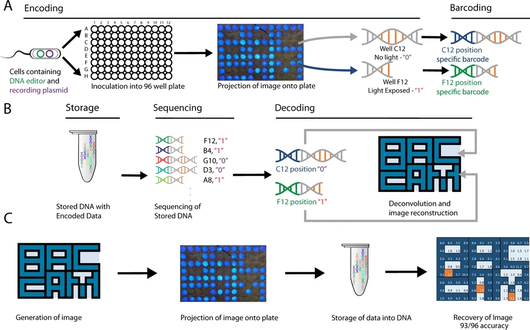
Cheng Kai Lim, Jing Wui Yeoh, Aurelius Andrew Kunartama, Wen Shan Yew & Chueh Loo Poh. “Workflow of BacCam (biological camera).” Wikimedia Commons, 3 July 2023. Image. CC BY 4.0. Accessed 10 Oct. 2026.
Published BacCam research workflow for encoding images in DNA. Image: Cheng Kai Lim, Jing Wui Yeoh, Aurelius Andrew Kunartama, Wen Shan Yew & Chueh Loo Poh; CC BY 4.0.
Reference links
- commons.wikimedia.org — reference 1_that_captures_and_stores_small_images_into_DNA_via_encoding_with_light.webp)
- creativecommons.org — reference 2
- news.microsoft.com — reference 3
- microsoft.com — reference 4
- microsoft.com — reference 5