What happens between typing a website name and seeing its first page? The name feels like an address, but the computers carrying the request need another kind of information. The Domain Name System, usually called DNS, connects names people can remember with addresses computers can use. Understanding that small translation helps explain why a working internet connection does not always produce a working website.
From a Name to an Address
Cloudflare explains that DNS translates domain names into Internet Protocol, or IP, addresses. A browser can then contact the appropriate service. The lookup and the delivery of the website are separate steps: finding an address does not create the page that will appear there.
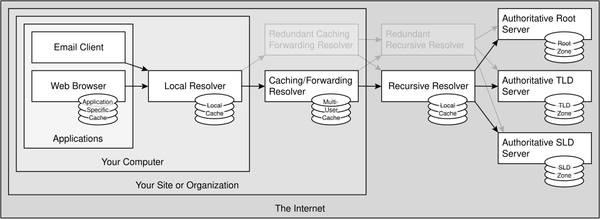
An uncached lookup can involve a resolver, root nameservers, a top-level-domain nameserver, and an authoritative nameserver. The resolver follows referrals until it obtains the requested record. Cloudflare also describes caching, which temporarily saves answers so a later lookup can skip some of that work. Each cached record has a time limit.
Think of a student looking for a school club's website. The student knows its name, while the network needs to know where to send the request. DNS supplies the connection between those two descriptions. In this hypothetical example, the student does not need to learn the website's numerical address each time its hosting arrangement changes.
Why the Organization Matters
ICANN explains that domain names form a hierarchy. Different organizations administer different parts, and a registrant can create names beneath a domain it controls. The familiar ending of a name is part of that organization, rather than a decoration attached to the website.
This arrangement lets a large naming system divide responsibility. A club maintaining its own site can focus on its domain's records instead of maintaining a directory for every website. The practical lesson is that a memorable name still depends on several organizations performing their individual jobs.
Finding the Right Problem
Imagine that the club moves its website and some visitors reach the new page while others temporarily reach the old location. Cached answers offer one possible explanation. The example shows why checking the name's records is a different task from checking the website's content.
A useful troubleshooting question is therefore about the stage that failed. Was the name resolved? Was the resulting address reachable? Did the website respond? Treating those as separate questions can prevent a team from changing the wrong part of its system.
Summary
DNS makes the internet easier to navigate by linking readable names with network addresses. Its value comes from a distributed naming structure and answers that can be reused for a limited time. A website's name may look simple on screen, but keeping that name useful requires records, coordination, and a clear understanding of what a lookup actually accomplishes.
Works Cited
Cloudflare. “What Is DNS?.” n.d. Accessed 10 Oct. 2026.
ICANN. “About Domain Names.” 30 Aug. 2018. Accessed 10 Oct. 2026.
Aaron Filbert. “DNS Architecture.” Wikimedia Commons, 30 August 2021. Image. CC BY-SA 4.0. Accessed 10 Oct. 2026.
Published illustration of the DNS resolution process. Image: Aaron Filbert; CC BY-SA 4.0.