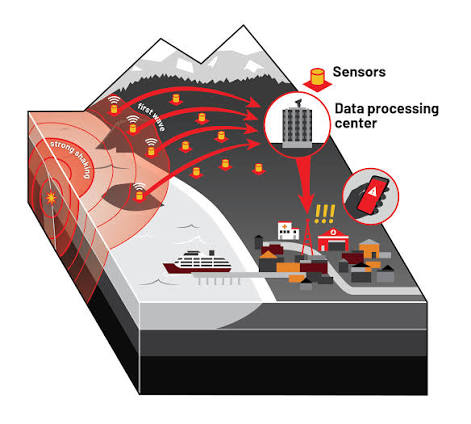
Most warning signals in our daily lives are things that can be foreseen hours or even days in advance. Earthquake early warning is a much shorter period, but one that enables critical actions to be taken that can prevent the loss of lives during ground tremors.
The USGS’s ShakeAlert earthquake early warning system detects an ongoing earthquake, then predicts its effects on the ground.
The information the system provides is used by technical partners to create alerts that enable people and systems to respond or react in a manner that could reduce damage and harm.
A few seconds’ worth of information can be used to do many things, from making a person remember to take cover to making a train slow down.
Communication is key when it comes to earthquake early warning, and it is the main reason why such systems only provide warnings for a very short time. Essentially, the faster an alert can be sent out through modern technology, the less danger there will be during an earthquake.
Like with all early warnings, it is important to be prepared for what is coming. The more a person or organization knows about possible consequences, the better their response should be. Likewise, organizations must determine what actions their systems should initiate when an alert is sent out.
Earthquake early warning is a great example of how technology can turn a minute window of opportunity into something remarkable. The detection of an earthquake and subsequent communication of information about it are only two parts of a much bigger process. A warning system can only do so much – it is up to humans and organizations to determine the best course of action.