Electronic Noses: Recognizing Vapors from a Pattern of Sensors
A smell usually contains more than one chemical, and identifying it is not always a matter of measuring a single substance. An electronic nose combines several responsive sensors with analysis of their collective pattern. The approach borrows a general idea from biological smelling without reproducing a human nose in full.
Why use a sensor array?
NASA technical material describes arrays of chemical-vapor sensors whose electrical responses change when exposed to different vapors. Individual elements can respond broadly, while differing in sensitivity. The combined response supplies more information than one element alone.
The system records the response pattern and compares it with known examples or a suitable analytical model. It may seek to distinguish a chemical, a mixture, or a defined sample category. The intended task determines what training and testing are needed.
A biological inspiration
NIST’s work on artificial olfaction combines cross-selective sensors with pattern recognition. Its research on an electronic nose used multiple sensing materials and controlled temperatures to obtain informative responses. This illustrates how the same general architecture can be implemented through different physical designs.
The device does not experience an odor or describe it in the same way a person does. It measures a set of signals and uses a model to classify or characterize them. Calling it a nose is a helpful analogy, not a claim of human sensory experience.
A hypothetical quality check
Imagine a manufacturer investigating whether a sensor array can distinguish two known vapor profiles in a controlled production setting. The team could collect reference measurements, then test samples that were not used to build the classification method.
This hypothetical project would need a clear definition of a correct answer. It would also need to evaluate ambiguous samples rather than forcing every measurement into a confident category. A device that recognizes familiar conditions may still struggle when the mixture changes.
Drift and background conditions
NASA’s evaluation material identifies changes in temperature, humidity, and pressure as influences on some sensors. NIST also discusses sensor drift and aging. These issues matter because a response may change even when the target chemical situation has not changed in the intended way.
A useful monitoring system therefore needs calibration and evidence across its expected environment. Testing only clean, isolated reference vapors may not establish performance in a mixed background. The report should specify the substances or categories it can distinguish and the limits of that distinction.
Summary
Electronic noses combine an array of chemical responses with pattern analysis. Their strength is information from the collective signal rather than perfect specificity in each sensor. Reliable use depends on representative reference data, changing background conditions, calibration, and a clearly defined identification task.
Works Cited
NASA Technical Reports Server. “Electronic “Noses” Made from Conductive Polymeric Films.” July 1997. Accessed 10 Oct. 2026.
National Institute of Standards and Technology. “Sniffing Out a Better Chemical Sensor.” 28 Oct. 2008. Accessed 10 Oct. 2026.
Young, Rebecca C., Bruce R. Linnell, and William J. Buttner. “An Evaluation of Electronic Nose for Space Program Applications.” n.d. Accessed 10 Oct. 2026.
Raman, Baranidharan, and Stephen Semancik. “Mimicking Biological Design and Computing Principles in Artificial Olfaction.” 27 May 2011. Accessed 10 Oct. 2026.
LukaszKatlewa. “Enose prototype Analytical Dept Chemical Faculty GUT Gdansk.” Wikimedia Commons, 21 November 2013. Image. CC BY-SA 4.0. Accessed 10 Oct. 2026.
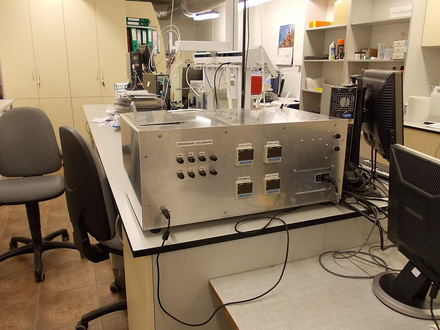
An electronic nose prototype at Gdańsk University of Technology. Image: LukaszKatlewa; CC BY-SA 4.0.