Error-Correcting Codes: How Extra Bits Rescue a Message
Can a message arrive correctly even when some of its bits are damaged? Digital communication depends on signals that travel through imperfect conditions. Error-correcting codes add carefully designed information to a message so a receiver can recognize certain mistakes and, within limits, reconstruct the original. The extra information has a purpose that ordinary repetition does not always accomplish efficiently.
Building in Redundancy
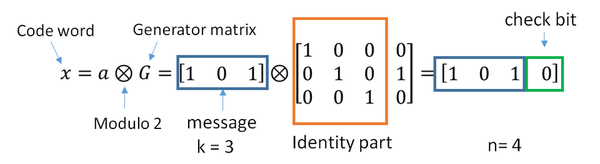
MathWorks describes block coding as a process that converts a group of message symbols into a larger group called a codeword. The added symbols create relationships the receiver can check. A decoder uses those relationships to determine whether the received block fits the code and whether an error can be corrected.
For a simple illustration, imagine sending each bit three times. A receiver that gets 101 could choose the majority value, 1. That example corrects one flipped bit in that group, but two flips would mislead it. Practical codes use more sophisticated structures, yet the central idea remains understandable: added information makes some damage recognizable.
The illustration is a teaching example, rather than a recommendation for a particular communications system. Its value is that it shows both the reason redundancy helps and the point at which that help runs out.
Detection and Correction Do Different Jobs
MathWorks's communications documentation distinguishes techniques for detecting errors from techniques for correcting them. A cyclic redundancy check can help detect corruption. Block and convolutional coding families support other forms of error control, including correction under specified conditions.
That distinction matters when a receiver has to decide what happens next. Recognizing that a file is damaged does not, by itself, supply the missing information. A system might need another transmission, or it might have enough redundancy to repair certain errors without asking the sender again.
Imagine a remote sensor sending a short measurement. If another transmission is difficult, some added bits may be worthwhile. If a fast connection can request a replacement immediately, the designer might make a different tradeoff. These hypothetical choices depend on the channel and the consequences of accepting the wrong value.
A Limit Is Part of the Design
MathWorks explains that a code's error-correction capability depends on its structure. Designers must therefore match a code to the kinds and amounts of errors they expect. Adding redundancy also means transmitting or storing more symbols for the same message.
The useful question is not whether a system has error correction, but what errors it can handle and what it does when that capability is exceeded. Testing should include difficult conditions, rather than only demonstrations in which one easy mistake is repaired.
Summary
Error-correcting codes turn deliberately added information into a way to recover some damaged messages. They illustrate a practical engineering exchange: extra data and processing can improve reliability. A successful design understands its correction limits, distinguishes detection from recovery, and chooses a response for errors that remain beyond the code's reach.
Works Cited
MathWorks. “Block Codes.” n.d. Accessed 10 Oct. 2026.
MathWorks. “Error Detection and Correction.” n.d. Accessed 10 Oct. 2026.
Kirlf. “Block code error correction.” Wikimedia Commons, 3 January 2019. Image. CC BY-SA 4.0. Accessed 10 Oct. 2026.
Published illustration of the information and check-bit portions of a block code. Image: Kirlf; CC BY-SA 4.0.