Floating Offshore Wind: Supporting Turbines in Deep Water
A wind turbine needs a stable foundation, but what happens when the seabed is far below the surface? Floating offshore wind places the turbine on a buoyant structure held in position by mooring lines. The design opens another way to use wind resources over deep water.
What keeps a floating turbine in place?
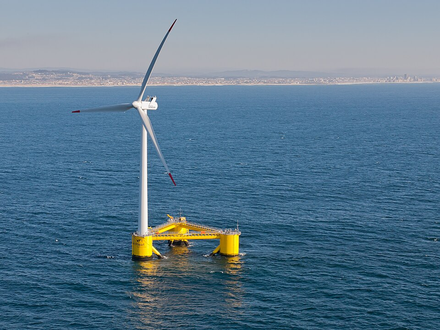
DOE’s Floating Offshore Wind Shot fact sheet explains that turbines can be mounted on floating foundations or platforms anchored to the seabed. The platform supplies buoyancy and stability, while the mooring system limits its movement and maintains position.
The turbine does not become free to drift around the ocean. Anchors, mooring lines, and their connections are essential equipment. DOE’s work on mooring and anchoring specifically treats these components as part of permanently securing a full-scale floating support structure.
Different ways to remain stable
DOE describes several platform concepts. A spar uses a large submerged mass to help maintain stability. A semisubmersible uses a broader arrangement of buoyant elements and ballast. Tension-leg platforms form another design family, using constrained connections to the seabed.
The best arrangement depends on the project. Water depth, seabed conditions, transport, assembly, and maintenance all need consideration. Comparing platforms solely by how unusual they look misses the practical work required to manufacture and operate them.
The turbine and platform work together
NREL’s 2020 discussion of floating-wind cost optimization emphasizes an integrated systems approach. The platform, turbine, plant configuration, and operating practices all influence cost and viability. A design cannot be assessed adequately by optimizing one component in isolation.
Imagine a proposed coastal project considering two platform designs. One might be convenient to assemble at the available port, while another might have a different offshore motion response. The project team would need to compare the complete installation and service plan. This is a hypothetical design comparison, not a claim that one concept is always superior.
Benefits and tradeoffs
Floating foundations can reach water depths where conventional fixed-bottom support becomes less suitable. That expands the range of possible sites. However, reaching a resource is only the beginning: the electricity still needs a dependable route to shore, and the equipment needs a workable maintenance strategy.
The marine environment makes accessibility important. A repair plan should account for the vessels, weather windows, and port facilities required. Project evaluation also needs to consider other ocean users and the surrounding environment. These questions belong in site planning alongside technical performance.
Early demonstrations and cost targets should be read carefully. A research goal represents work to be achieved, not proof that every commercial project has already reached that cost. The cited DOE and NREL material is used here to explain design principles rather than assert a current market price.
Summary
Floating offshore wind combines turbines, buoyant platforms, and seabed moorings into one operating system. It can expand access to deep-water wind resources. Practical success depends on stability, installation, maintenance, and the cost of the whole project.
Works Cited
U.S. Department of Energy. “Floating Offshore Wind Shot Fact Sheet.” Sept. 2022. Accessed 10 Oct. 2026.
U.S. Department of Energy. “Wind on the Waves: Floating Wind Power Is Becoming a Reality.” n.d. Accessed 10 Oct. 2026.
National Renewable Energy Laboratory. “NREL Floats New Offshore Wind Cost Optimization Vision.” 7 Aug. 2020. Accessed 10 Oct. 2026.
Untrakdrover. “Agucadoura WindFloat Prototype.” Wikimedia Commons, 9 March 2012. Image. CC BY-SA 3.0. Accessed 10 Oct. 2026.
The WindFloat floating wind turbine prototype off Portugal. Image: Untrakdrover; CC BY-SA 3.0.