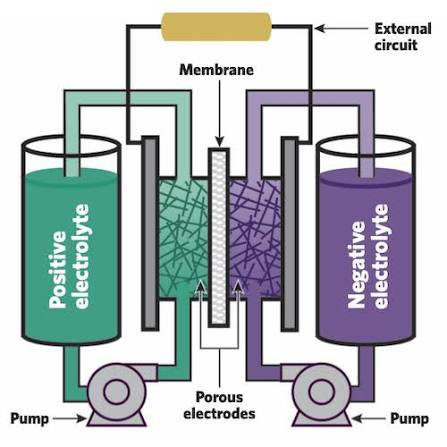
A person may think of a battery as a small device that powers a phone or car. Flow batteries use an electrochemical process with liquid electrolytes and specialized equipment. The design of a flow battery represents an alternative approach to the challenge of storing electricity for later use.
The Functionality
The flow battery uses chemical reactions to either store or release electricity. In this type of battery, liquid electrolytes are used and moved in order for the reaction to take place.
According to the Department of Energy, flow batteries are a promising technology with regard to electricity-grid applications. The technology allows for large-scale electricity storage and has longevity as an advantage.
The Entire System
In addition to the chemical properties of a flow battery, manufacturers must consider the impact on materials, design, and the costs associated with the proposed solution.
When considering a method to store electricity in a facility, a manager would need to think about the amount of electricity that would need to be stored. The manager would also need to determine the time frame in which the electricity would be needed. Additional considerations would include the frequency of use and issues of installation and maintenance.
These factors indicate that the issue of storage is a complex one in which a given technology may be ideally suited to a specific application.
Summary
The design differences of a flow battery contribute to its promise as a method to store electricity. The importance of the technology is linked to the degree to which its properties match the requirements of a structure or system. As with other methods, the value of a flow battery depends upon consistent performance and an understanding of costs.