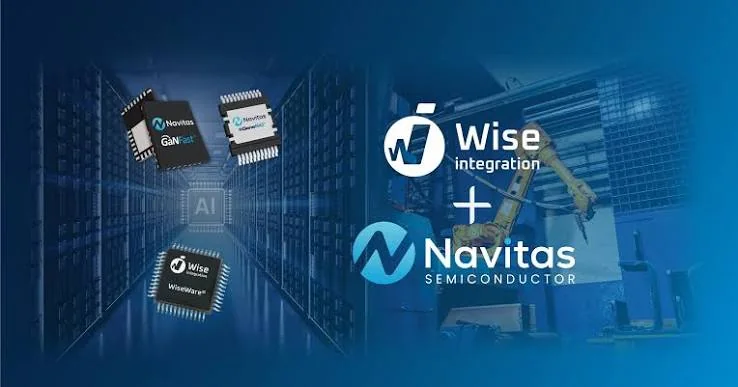
The exponential growth of high-density AI compute clusters driven by megawatt-scale accelerator deployments presents new challenges to data center power delivery networks. Silicon-based Power Supply Units (PSUs) are reaching physical limits to power density in standard server rack form factors.
Power Electronics engineers are adopting Gallium Nitride (GaN) Digital Power Conversion approaches as a solution, with pioneering architectures from companies such as Navitas Semiconductor and Wise Integration implementing wide-bandgap (WBG) GaN power ICs and high-frequency digital control loops to enable next-generation Titanium and Ruby-grade power conversion efficiencies across ultra-dense rack configurations.
1. Thermal & Density Bottlenecks in Silicon-Based Data Center Power Subsystems
Legacy power conversion architectures in high-performance computing (HPC) facilities face severe physical and operational limits:
Silicon MOSFET Switching Frequency Limits: Traditional silicon switches operate at relatively low frequencies (). Driving silicon switches at higher frequencies results in catastrophic switching losses, generating excessive waste heat.
Volumetric Inductive & Capacitive Bulk: Operating at lower switching frequencies requires physically large passive components (transformers, inductors, and capacitors), limiting PSU power density to legacy levels ().
Thermal Dissipation & Airflow Obstruction: High parasitic conduction and switching losses in silicon PSUs result in high thermal dissipation loads, necessitating larger heatsinks and high-RPM cooling fans that consume additional rack power and impede thermal airflow.
2. GaN Semiconductor Physics & Monolithic Power Integration
Gallium Nitride has superior material properties to legacy silicon, allowing for rapid switching and integrated gate-driver architectures:
Superior Bandgap & Critical Electric Field: With a wide bandgap ( vs. for silicon) and high critical electric field (), GaN devices are able to support higher breakdown voltages across thinner drift layers, drastically reducing specific on-state resistance ().
High Electron Mobility Transistor (HEMT) Channel: The two-dimensional electron gas (2DEG) channel formed at the AlGaN/GaN heterojunction allows for ultra-low gate charge () and near-zero reverse recovery loss (), allowing for clean switching frequencies above .
Monolithic GaN Power ICs (Navitas GaNFast & Wise Integration WiseGAN): Power switches, gate drivers, control logic, and protection circuits integrated onto a single GaN die eliminate parasitic interconnect inductances, preventing high-frequency ringing and enabling sub-nanosecond switching transitions.
3. High-Frequency Digital Topologies & Resonant Converters
To maximize conversion efficiency from or down to / point-of-load (PoL) rails, GaN-based PSUs leverage advanced digital power topologies:
Totem-Pole Bridgeless Power Factor Correction (PFC): Replacement of high-loss diode bridges with low-loss GaN HEMTs in continuous conduction mode (CCM) achieves $>99\%$ PFC stage efficiency with reduced front-end component counts.
LLC Resonant DC-DC Converters: Utilizing GaN switches in high-frequency resonant LLC stages achieves Zero-Voltage Switching (ZVS) across the entire load spectrum, virtually eliminating turn-on switching losses and allowing for massive reductions in transformer core size.
Digital Signal Processor (DSP) & MCU Co-Design: High-speed digital controllers adjust dead-time intervals, switching phases, and burst-mode operations in real time based on dynamic AI workload spikes to maintain flat efficiency curves above $97.5\%$ across broad load ranges.
4. Industrial Deployment, Rack Power Density & Carbon Reduction
Deploying GaN-driven power delivery systems fundamentally alters data center infrastructure scaling:
Multi-Kilowatt Form Factor Density Scaling: GaN power conversion enables PSUs to deliver per module in standard CRPS (Common Redundant Power Supply) footprints, enabling power densities beyond .
AI Rack Capacitance Unlocking: Higher PSU efficiency reduces rack-level thermal dissipation and frees up power headroom, allowing hyperscalers to pack additional GPU/TPU accelerator cards into existing server chassis without exceeding total power envelopes.
Hyperscale Energy Conservation: Transitioning global AI data centers from silicon to GaN-based Titanium-grade PSUs eliminates gigawatt-hours of conversion losses annually, reducing cooling energy demands and overall Scope 2 carbon emissions.
Sources
- Wise Integration. (2026, September 25). Graphic illustrating the collaboration between Wise Integration and Navitas Semiconductor for high-performance AI computing power conversion [Digital graphic]. Wise Integration. https://wise-integration.com/wise-integration-and-navitas-collaborate-to-advance-performance-computing-applications-for-ai-pcs-high-end-workstations-gaming-desktops-and-industrial-systems/