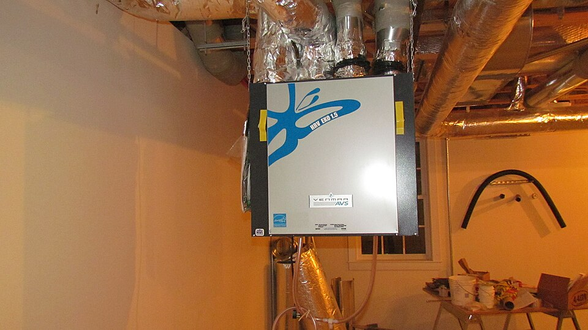
Heat-Recovery Ventilation: Fresh Air with Less Lost Heat
A building can be well insulated and still need a planned supply of outdoor air. Bringing that air indoors can increase heating or cooling demand. Heat-recovery ventilation addresses the problem by exchanging thermal energy between outgoing and incoming air streams.
What the equipment does
DOE’s Building Science Education program describes heat-recovery ventilators, or HRVs, as systems containing a heat exchanger, fans, and controls. During cold weather, heat from exhaust air helps warm the incoming air. During hot weather, the outgoing indoor air can help reduce the temperature of the incoming supply.
Energy-recovery ventilators, or ERVs, also transfer some water vapor. This makes the distinction between HRV and ERV important: the systems have related goals, but their treatment of moisture differs. A building’s climate and operating needs help shape which arrangement is appropriate.
The purpose is to recover useful energy while maintaining ventilation. A heat exchanger is not a substitute for bringing in outdoor air, nor does recovering heat make every other air-quality issue disappear. The amount and distribution of air still need to match the building’s requirements.
An example in an efficient building
Imagine a renovated reading room with new insulation and fewer drafts. A planned ventilation system could supply outdoor air to occupied spaces and remove exhaust air through a heat-recovery unit. Its designer would consider both the energy balance and where the air actually travels.
A successful project would make ordinary operation understandable to staff. They should know what the controls indicate, where filters are located, and when maintenance is needed. This is a hypothetical example of project planning rather than an installation instruction.
Why maintenance matters
DOE’s whole-house ventilation brochure explains that heat-recovery systems need regular cleaning. Condensate may have to be drained, and cold conditions can create frost in the heat exchanger. Appropriate frost-management features therefore matter where the climate requires them.
The brochure also points out that the fans consume electricity. In a mild climate, additional fan energy can weaken the benefit of recovering heat. This is why the whole system must be evaluated rather than considering the exchanger’s rated recovery alone.
Noise, duct arrangement, access for maintenance, and airflow balancing are useful practical questions. A system hidden in a difficult-to-reach space may be less convenient to maintain. Likewise, well-designed equipment cannot compensate for an air path that does not serve occupied rooms effectively.
Summary
Heat-recovery ventilation exchanges energy between exhaust and supply air to reduce the cost of ventilation. ERVs add moisture transfer to that function. The technology works best when airflow, climate, controls, fan energy, and maintenance are considered together as parts of the building’s ventilation plan.
Works Cited
U.S. Department of Energy, Building Science Education. “HVAC Energy Recovery Ventilation.” n.d. Accessed 10 Oct. 2026.
U.S. Department of Energy. “Whole-House Ventilation Systems: Improved Control of Air Quality.” n.d. Accessed 10 Oct. 2026.
National Institute of Standards and Technology. “NIST 1770 (7788039192).” Wikimedia Commons, 18 April 2012. Image. Public domain. Accessed 10 Oct. 2026.
A heat-recovery ventilator at NIST’s residential test facility. Image: National Institute of Standards and Technology; Public domain.