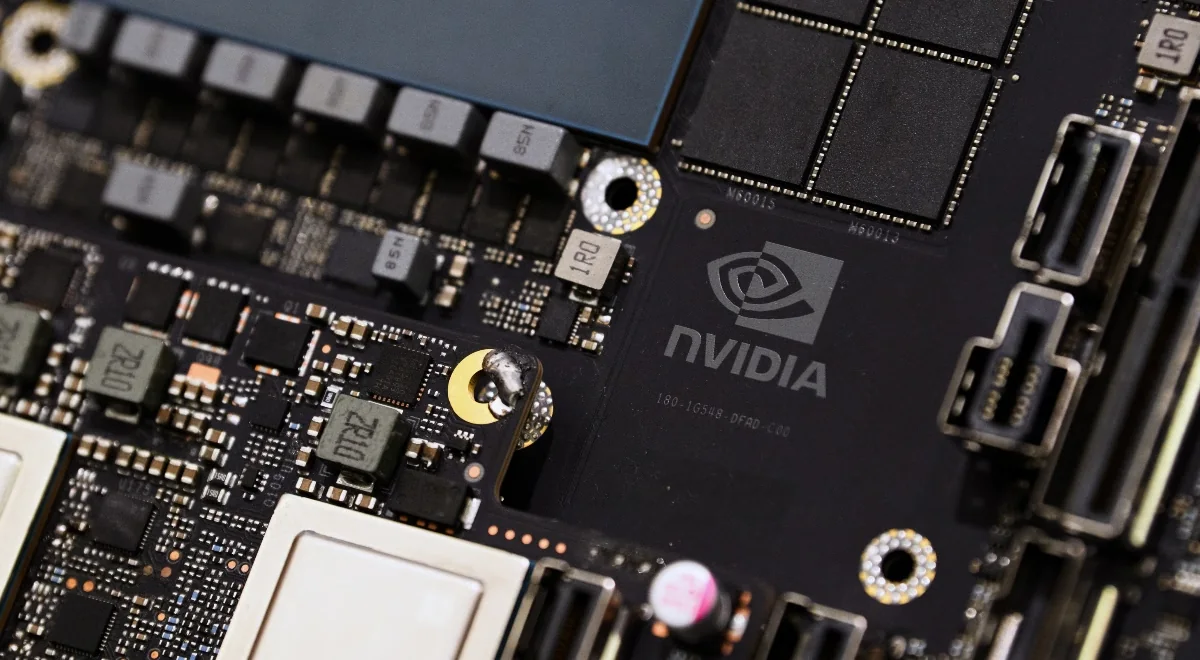
The boundary between artificial intelligence and quantum computing moved significantly closer this month. In an industry milestone, IonQ announced that its sixth-generation Superion 256 quantum processing unit (QPU) will be the first on-premise quantum computer at the NVIDIA Accelerated Quantum Research Center (NVAQC).
By linking trapped-ion quantum hardware to NVIDIA’s AI supercomputers, the partnership lays groundwork for a new era of hybrid quantum-classical computing.
1. On-Premise Supercomputer Convergence: QPU + GB200 NVL72
While early quantum-classical hybridizations were limited to latency-inducing cloud APIs, IonQ and NVIDIA are pioneering a new level of intimacy through direct interconnect.
Physical Co-Location: The IonQ Superion 256 will be installed on the same facility with an NVIDIA GB200 NVL72 system and directly connected via NVQLink. The quantum computer is constructed on standard foundry process technology at IonQ’s SkyWater facility, making it rack-mountable. This allows colocating the Superion 256 within AI supercomputing centers without requiring disruptive infrastructure upgrades.
Unified Execution Stack: The combined workload of quantum processing and GPU-accelerated CPU instructions will be managed by NVIDIA CUDA-Q, an open standard for hybrid quantum-classical computing.
2. Generative AI Breakthrough Enables On-the-Fly Circuit Optimization
The quantum computer maker and graphics silicon giant have announced ambitious joint research plans.
At IEEE Quantum Week this month, researchers from IonQ, NVIDIA, ORNL, and the University of Tennessee published an invited paper describing a groundbreaking new application of generative artificial intelligence. The team showed that quantum circuits could be synthesized and optimized for execution on a trapped-ion QPU with none of the usual trial-and-error overhead.
Eliminating Parameter Guesswork: Until now, it has taken hundreds of iterations to design a quantum circuit that can successfully solve a optimization problem. By contrast, the new AI-driven approach generates a circuit capable of producing twice the accuracy on benchmark problems with 100 variables.
On-the-Fly Rewriting: When applied to challenging optimization tasks, conventional circuit synthesis methods exhibited an exponentially increasing run time as the number of variables increased. By comparison, the new method demonstrated a roughly linear increase in time required while maintaining its accuracy advantage.
Real-Time Calibration and Noise Modeling: By virtue of running on NVIDIA GPUs, the new AI models can continuously perform error mitigation and qubit recalibration while the quantum computer is performing its calculations.
3. Target Areas: Chemistry, Finance, Materials Science
The combination of trapped-ion quantum computing and graphical processors’ immense linear algebra capabilities is set to produce profound results in fields long ruled by classical computation.
Some of the most compelling applications for the hybrid supercomputer would include:
Computational Chemistry: The simulation of physicochemical processes from protein folding to catalysis by offloading quantum mechanical calculations to the Superion QPU while classical interatomic forces are managed by GPUs.
Materials Discovery: First-principles modeling of novel materials and high-temperature superconductors using hybrid quantum algorithms.
Quantum Finance: The use of quantum algorithms to perform high-dimensional option pricing and Monte Carlo simulations in financial risk assessment.
4. Fault-Tolerant Quantum Computing Ahead
Industry experts believe that the NVAQC’s Superion 256 deployment represents a critical step toward physical fault-tolerant quantum computers. By taking over error correction and circuit synthesis duties, GPUs can be viewed as the enablers that make large-scale quantum machines possible.
Sources
- Kon, A. / Bloomberg via Getty Images. (2024, November 19). An NVIDIA processor chip mounted on a circuit board [Photograph]. Cybernews. https://cybernews.com/ai-news/nvidia-google-quantum/