Lab-on-a-Chip Microfluidics: Moving Laboratory Work into Tiny Channels
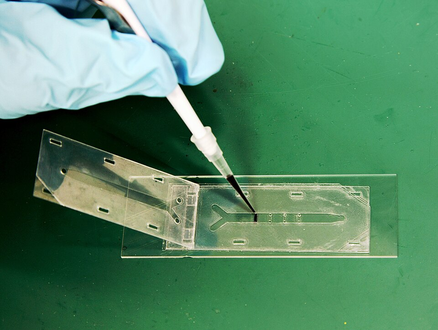
A laboratory experiment often involves tubes, containers, and carefully measured liquids. Microfluidic devices shrink some of those operations into tiny channels and chambers. A lab-on-a-chip system can guide small fluid samples through a planned sequence of preparation and measurement.
What is being miniaturized?
NIST describes lab-on-a-chip devices as systems that prepare and analyze very small fluid volumes. The chip is a physical network for fluids, not necessarily a computer processor. Its channels and reservoirs determine where samples travel and collect.
A device can contain several steps that would otherwise require separate handling. The potential attraction includes working with small amounts of material and controlling the path through a compact system. But the complete instrument may still need pumps, connections, detectors, and other supporting equipment.
Dimensions affect the result
NIST’s work on measuring microfluidic channels explains why manufacturing consistency matters. If a measurement depends on the volume of a chamber or channel, errors in its dimensions can affect the reported result. A drawing of a precise structure does not guarantee that every manufactured device has that structure.
The agency investigated methods for measuring internal dimensions as part of addressing this quality-control problem. This illustrates a general principle: miniaturization makes measurement and verification more important, not less.
A hypothetical testing workflow
Imagine a materials laboratory comparing several liquid formulations on a small chip. The team could introduce controlled samples, guide them through channels, and observe their responses in a measurement region. It would record the input amounts, flow conditions, and the detector’s behavior.
The proposed experiment would need an appropriate comparison with established measurements. If the chip produces different results, the team should determine whether the difference comes from the formulation, the device geometry, or the handling method. Small equipment does not remove the need for a clear experimental design.
Standards and repeatability
NIST’s discussion of commercialization argues for testing standards. Different groups need a way to compare device performance and communicate what has been measured. A promising single prototype is not the same as a repeatable product that users can rely on.
For an actual application, the supporting workflow also matters. How is the sample introduced? Can unwanted residue affect a later measurement? Which materials contact the fluid? How is the result checked? These questions connect the chip with the laboratory task it is intended to serve.
Summary
Lab-on-a-chip microfluidics moves suitable fluid-handling and measurement operations into small channels and chambers. Its appeal comes from compact, controlled use of small samples. Its practical success depends on reliable dimensions, repeatable flow and detection, and validation of the complete process.
Works Cited
National Institute of Standards and Technology. “NIST Technique Can Measure Volumes of Key “Lab on a Chip” Components.” 17 Apr. 2015. Accessed 10 Oct. 2026.
National Institute of Standards and Technology. “NIST Focuses on Testing Standards to Support Lab on a Chip Commercialization.” 8 Aug. 2012. Accessed 10 Oct. 2026.
National Institute of Standards and Technology. “Polymer Formulations.” n.d. Accessed 10 Oct. 2026.
Cooksey/NIST. “Microfluidic Device (6842746147).” Wikimedia Commons, 30 April 2010. Image. Public domain. Accessed 10 Oct. 2026.
A microfluidic device developed by NIST researchers. Image: Cooksey/NIST; Public domain.