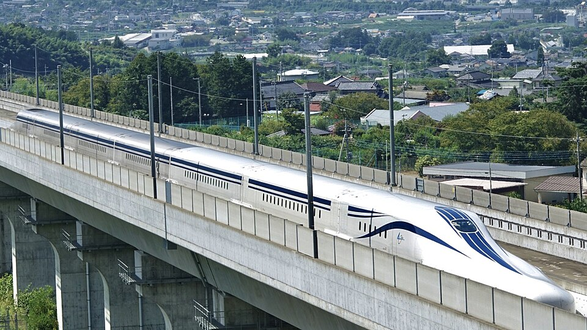
Maglev Trains: Suspension, Guidance, and Propulsion by Magnetic Fields
A maglev vehicle can travel without relying on ordinary wheel contact for its main high-speed support. Magnetic fields provide suspension and, in many designs, guidance and propulsion. The technology is as much about a specialized guideway as it is about the train itself.
Three functions to coordinate
The Federal Railroad Administration’s National Maglev Initiative report identifies levitation, propulsion, and guidance as the three primary functions. Levitation supports the vehicle, guidance keeps its path controlled, and propulsion moves it along the route. Different designs can accomplish these functions in different ways.
The report distinguishes suspension concepts including electromagnetic attraction and electrodynamic approaches. These require different arrangements of magnets, guideway components, and control. Maglev should therefore be understood as a family of systems rather than one standard machine.
The guideway is active infrastructure
DOE’s explanation presents a superconducting-maglev concept in which magnets on the vehicle interact with conductive loops in a guideway. Separate arrangements support suspension, horizontal stability, and propulsion. Powered magnetic fields can push and pull the vehicle along its path.
That example illustrates one design, not every maglev installation. The physical guideway and its electrical systems are central. A vehicle cannot simply be placed on any existing railway and expected to operate as a maglev service.
A hypothetical route comparison
Imagine planners studying a connection between two busy centers. They could compare maglev with other transport options using the same passenger-demand assumptions. The assessment would include stations, transfers, construction, energy use, operating costs, and the surrounding transport network.
This hypothetical comparison is broader than asking which vehicle has the highest possible speed. A traveler experiences the full journey: reaching a station, waiting, riding, and making a final connection. A fast section of guideway may or may not improve that complete trip enough to justify its cost.
Benefits and limits
Magnetic suspension changes the vehicle’s contact with its supporting infrastructure. It can reduce issues associated with ordinary rolling contact during levitated operation. However, aerodynamic resistance, electrical demand, braking, maintenance, and dependable control still matter.
The guideway also needs appropriate tolerances and structural performance. FRA’s work treats guideway and route integrity as engineering requirements, showing why the infrastructure cannot be treated as an incidental track beneath an advanced train.
A convincing proposal should state which design is being assessed and distinguish a test result from a complete operating service. Construction and long-term maintenance need the same attention as vehicle performance.
Summary
Maglev coordinates magnetic suspension, guidance, and propulsion through a specialized vehicle–guideway system. Its appeal includes a different form of support and movement. Its practical value depends on the whole route, its infrastructure, operating reliability, and the journeys it serves.
Works Cited
Federal Railroad Administration. “National Maglev Initiative: Final Report.” n.d. Accessed 10 Oct. 2026.
U.S. Department of Energy. “How Maglev Works.” n.d. Accessed 10 Oct. 2026.
Federal Railroad Administration. “Maglev Guideway and Route Integrity Requirements.” 1991. Accessed 10 Oct. 2026.
Saruno Hirobano. “L0-950.” Wikimedia Commons, 29 August 2020. Image. CC BY-SA 4.0. Accessed 10 Oct. 2026.
An L0-series maglev train in Japan. Image: Saruno Hirobano; CC BY-SA 4.0.