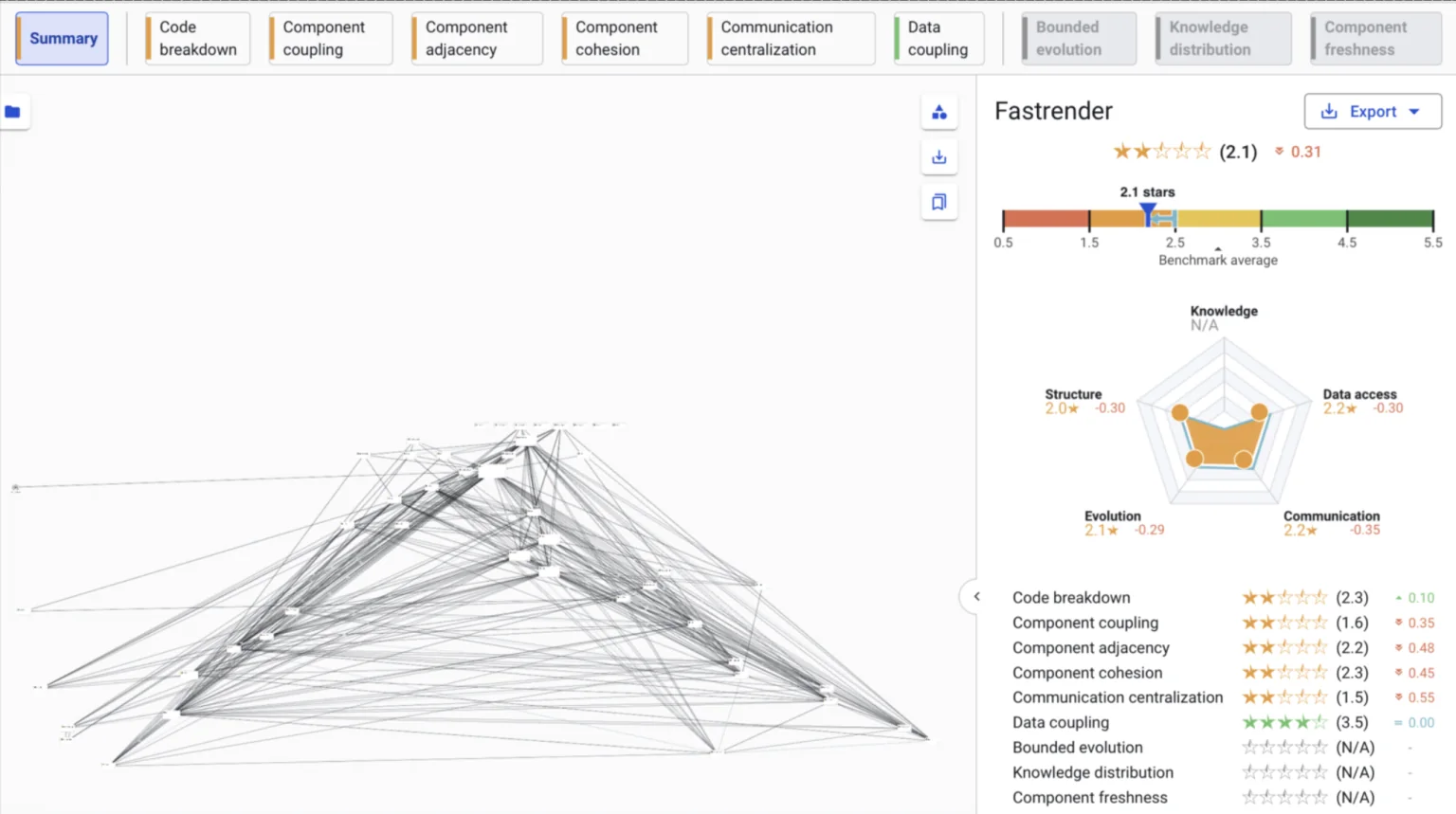
Source: http://softwareimprovementgroup.com/blog/architectural-debt-ai/
The use of generative artificial intelligence coding assistants has fundamentally changed the way developers release software. By generating boilerplate routines, writing entire microservices, and interpreting natural language prompts to target syntax, large language models give engineering teams immense gains in terms of velocity. But beneath this boost lies a hidden cost that teams are only slowly realizing: the lack of maintainability of software written with the aid of generative artificial intelligence. Software developed with generative coding assistants has technical debt and architectural drift that no longer appear as clear negative feedback loops to people who write production-grade software. Unlike normal technical debt, where engineers actively take on more debt to get features shipped faster, the forms of technical debt introduced by generative coding assistants have some substantial differences. When software professionals normally introduce technical debt, say by writing a particularly hacky solution to a problem, they usually leave behind clear hints as to what issues to address to clean the code up. But when code smells are generated by an AI, there is significantly less of a visible trace as to what issues to tackle. The generated code appears substantially cleaner and more production-ready than equivalent code smells written by humans. But beneath the surface, large language models frequently introduce subtle code smells and correctness issues that appear as innocuous additions to a commit message, but which nonetheless detract from the overall quality of the codebase. In practice, many of these issues have to be addressed in later commits because existing commit reviews and even commit diffs do not adequately surface correctness and code smell issues introduced by generative coding assistants. But beyond the issues of technical debt, the more worrying problem with regard to generative coding assistants is their contribution to the development of architectural drift within a codebase. Architectural drift occurs when the interactions between different elements of a larger system begin to change in ways that are incompatible with how the different elements were initially designed to work with each other. Generative coding assistants do not have a holistic view of an enterprise codebase, and tend to introduce changes that appear to make sense within the context of a single file but which fundamentally rewrite how the different elements of a system interact. When developers use generative coding assistants to make broad changes across an entire codebase, the lack of a holistic view of a system leads to a series of relatively minor architectural inconsistencies that add up to a substantial rewrite being necessary at a later date. Addressing the key drivers of maintainability issues within synthetic codebases generated with the aid of generative coding assistants requires a paradigm shift within engineering teams and their code review processes. The kinds of issues introduced by generative coding assistants are significantly more challenging to review at the code review stage, particularly for human reviewers who may find themselves sifting through hundreds of lines of plausible AI-generated code. Engineering teams need to consider additional architectural guardrails that can be actively enforced by CI/CD pipelines for subsequent code commits. Teams should establish paved roads within their software development processes to reduce the surface area within which generative coding assistants operate and where incorrect architectural assumptions can be introduced. But to fully leverage the gains offered by generative artificial intelligence while limiting the costs associated with reduced maintainability of such codebases requires a holistic approach to software architecture.
Sources
https://www.softwareimprovementgroup.com/blog/architectural-debt-ai/ https://amplifyit.io/blog/ai-generated-code-tech-debt https://arxiv.org/html/2603.28592v2