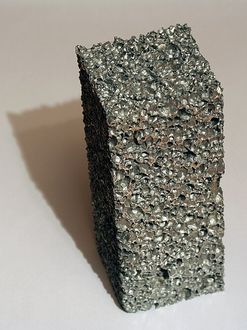
Metal usually brings to mind a dense sheet or a solid block. A metal foam contains many pores, giving it a structure that can behave very differently. Engineers use that internal space to pursue lighter components, controlled energy absorption, and other useful properties.
What changes when metal has pores?
Fraunhofer IFAM describes both open-cell and closed-cell metal foams. Open-cell structures have connected pore space, while closed-cell structures contain more enclosed cavities. Their properties depend on the metal, density, and pore arrangement.
Fraunhofer identifies low density, useful stiffness relative to weight, energy absorption, and damping among the attractions of porous metals. Open structures also provide substantial surface area and contact with surrounding fluids. These are possibilities offered by a design family, not guarantees that every foam is suitable for every task.
How a foam can be made
One Fraunhofer process mixes metal powder with a small amount of blowing agent, compacts it, and then heats it so that the material expands into a porous structure. Other manufacturing approaches produce different arrangements. The choice affects both the component and the way it can be joined to other materials.
Foam can also be used as part of a composite, such as a core combined with conventional metal sheets. In that arrangement, the surrounding skins and the porous core contribute different functions. The useful object is the complete panel or component, rather than an isolated sample of foam.
An illustrative design comparison
Imagine a manufacturer evaluating a protective enclosure for a delicate instrument. A foam-filled panel might be one candidate alongside a conventional panel. The team would compare mass, space, attachment details, and the forces transmitted during a representative test.
It would also need a clear definition of success. A material that absorbs energy by permanently deforming may need replacement after an event. A component that remains usable afterward has a different design requirement. This hypothetical example shows why the intended failure behavior matters as much as strength.
What research can and cannot establish
NC State has reported research on composite metal foam protecting carbon steel against puncture. That is a specific research context, illustrating the interest in energy absorption. It should not be read as proof that an arbitrary foam panel will protect any object under any impact.
For an actual product, repeatability and inspection are important questions. How consistent is the pore structure? How do connections behave? What happens after repeated loads or exposure to the service environment? A manufacturing team needs evidence appropriate to its own component and conditions.
Summary
Metal foams turn porosity into a design variable. Their internal structure can reduce weight and change how a component responds to forces or fluids. The strongest applications connect material properties with a specific geometry, manufacturing method, and tested operating requirement.
Works Cited
Fraunhofer IFAM. “Metal Foams – Innovative Materials for a Wide Range of Applications.” n.d. Accessed 10 Oct. 2026.
NC State University. “Study: Composite Metal Foam Could Lead to Safer Hazmat Transportation.” Nov. 2025. Accessed 10 Oct. 2026.
Stehfun. “Aluminium foam.” Wikimedia Commons, 25 October 2007. Image. CC BY 3.0. Accessed 10 Oct. 2026.
A sample of aluminium foam. Image: Stehfun; CC BY 3.0.