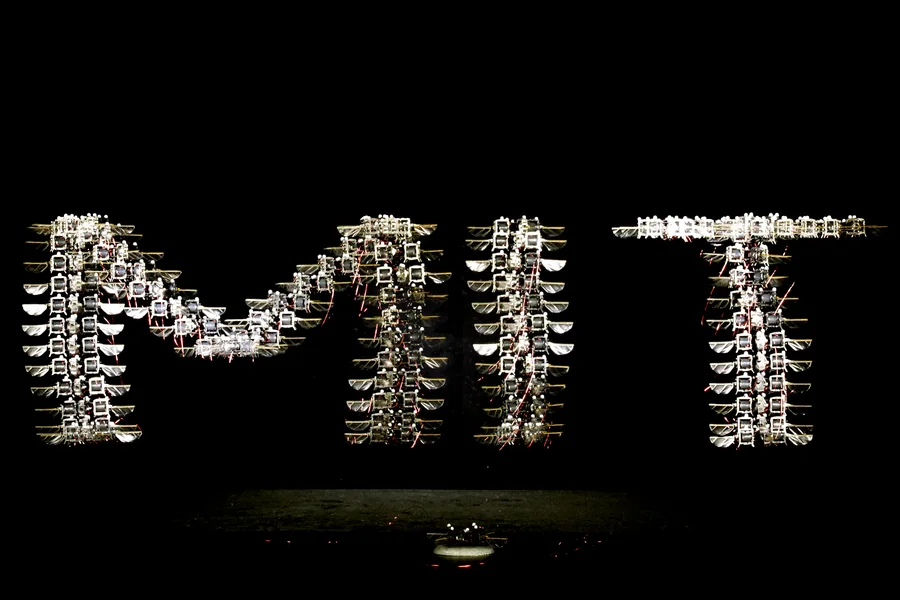
The field of micro-robotics was advanced by researchers at the Massachusetts Institute of Technology who developed a two-part artificial intelligence control framework. The bug-sized drone that weighs less than a paperclip and is powered by soft artificial muscles can now fly at speeds more than 4 times and accelerate 2.5 times faster than previously recorded metrics.
Published in Science Advances, the study showcases how deep learning can encode complex aerodynamic control algorithms into a real-time decision engine, allowing micro-drones to perform acrobatic flips.
1. Soft Actuators Enable High-Frequency Flapping Aerodynamics
Having worked on microrobotics for more than five years, Professor Kevin Chen and his team have developed a sub-gram insect-scale platform and a microcassette-sized frame that utilizes soft dielectric elastomer actuators.
Soft Artificial Muscles: The robot’s wings are manipulated by squishy artificial muscles that contract and relax rapidly to achieve high-frequency flapping of the wings.
Aerodynamic Complexity: Due to their miniature size, micro-drones are subjected to aerodynamic nonlinearities, air resistance, and wind disturbances that simple micro-drone controllers made of conventional quadcopter electronics cannot respond to quickly enough.
Physical Durability: Enhanced hardware design allows greater flapping amplitude while also elongating the wing hinges by three times to achieve 3X more control torque than earlier versions to handle the aggressive maneuvers.
2. Two-Step AI Controller Allows Real-Time Aerobatics with Model Predictive Planning and Imitation Learning
Chen worked in collaboration with Professor Jonathan How to devise a hybrid control framework that could meet the computational demands of high-speed flight while also being light enough to be incorporated into a micro-drones electronics.
Model-Predictive Control: An expert offline planner utilizes mathematical models to determine the best possible trajectory that takes into account the robot’s force and torque limits. The planner was able to dictate rapid and successive somersaults and saccadic whole-body maneuvers during testing.
Imitation Learning Policy: To reduce the massive computational requirements for real-time execution on-board, the researchers trained a neural network policy to imitate the expert planner. This allowed the robot to compress the extensive and computationally intensive planning algorithms required to execute high-speed turns and flips, essentially creating a lightweight, agile decision engine.
3. Experiments Show Microrobot Can Perform High-Speed Flight Maneuvers and Reject Disturbances
During testing, the microrobot set a number of speed and maneuverability records for a sub-gram robot in a controlled environment.
Sustained Acrobatics: During a 10-some-somersaults test, the robot was able to maintain a repeatable, precise flight path within a 4 to 5-cm range of the desired trajectory.
Rejection of Disturbances: The neural policy was able to counteract artificially generated wind gusts of more than 1 m/s and other disturbances such as tether wrap disturbances without losing altitude or crashing.
Insect-Like Saccades: Finally, the microrobot was able to demonstrate rapid directional maneuvers similar to saccades—rapid, jerky movements typical of insects.
4. Insect-Scale Drones with Agile Control Systems Enable New Classes of Search-and-Rescue Missions
By bridging the performance gap between man-made micro-drones and their biological counterparts, the researchers at MIT have defined a new standard for autonomous micro-aircraft. Insect-scale robots that can sustain flight after withstanding harsh impacts and navigate through tight environments can lead the way into previously inaccessible domains of search-and-rescue.
Sources
- MIT Soft and Micro Robotics Laboratory. (2025, January 15). A stroboscopic time-lapse photograph showing the flight path of a flying microrobot tracing out the letters "MIT" in a dark room [Photograph]. MIT News. https://news.mit.edu/2025/fast-agile-robotic-insect-could-someday-aid-mechanical-pollination-0115