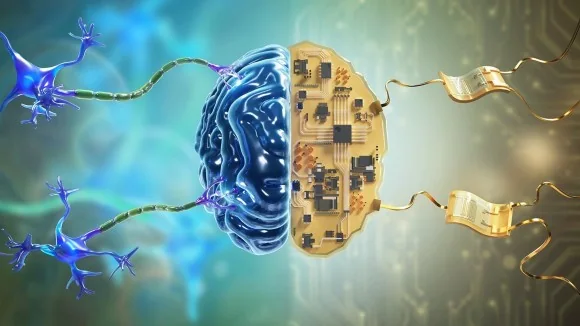
Source: https://www.nature.com/collections/jaidjgeceb/content/neuromorphic-architectures-and-hardwar e The rapid progress of artificial intelligence has placed a strain on traditional computer hardware. CPUs and GPUs are excellent aids to cognition and can perform calculations with massive floating-point precision, but are hampered by the von Neumann bottleneck. The fundamental design of allocating memory separately from processing power requires massive amounts of energy to be constantly transferred between memory banks and processors, resulting in high levels of power consumption and heat production. Real-time robotics, edge computing, and other applications that require quick responses from limited hardware resources are further strained by these physical limitations. Computer scientists have begun to look to alternative approaches to information processing in the human brain for inspiration on how to develop alternate physical hardware and neural network architectures that can circumvent the von Neumann bottleneck. Biological brains manage to produce complex behaviors, reason, and navigate the world while consuming only about twenty watts of power. Two fundamental design features that grant the brain this extraordinary level of efficiency are the close physical relationship between memory and processing, and the use of sparse encoded representations. In conventional artificial neural networks, layers of nodes are connected with weighted edges and must constantly perform mathematical operations on these weights regardless of their activation state. These constantly firing artificial neurons burn through energy even when idle. In contrast, biological neurons communicate in discrete pulses of electricity called action potentials, and only fire when their membrane potential breaches a certain threshold. Spiking neural networks communicate across synapses using these electrical pulses and only burn energy when actively transmitting signals. The principles of spiking neurons can be applied in physical hardware called neuromorphic cores to make processors with drastically reduced power consumption. Rather than the clock cycle and shared memory bus of von Neumann architectures, neuromorphic processors use massive parallelism across cores to process information. Each core has internal memory storing synaptic weights, and individual neurons that update their membrane potential. IBM’s TrueNorth and Intel’s Loihi are examples of neuromorphic processors that use packet-switched memory access rather than shared memory banks. When a spiking neuron fires, it sends a minuscule packet of information down interconnects to downstream neurons. The elimination of clock cycles and shared memory access reduces power waste, while the sporadic nature of spikes reduces the amount of information that must be processed at any given time. The energy efficiency of spiking neural networks and neuromorphic processors is difficult to gauge without direct comparison to existing von Neumann architectures. Traditional GPUs and CPUs run deep neural networks that use dense representations for their nodes. These processors must constantly perform mathematical operations on weights and values even if nothing has changed, which dramatically reduces efficiency. While theoretically possible to encode spikes in traditional floating-point values, doing so requires massive amounts of computational power to perform these operations on every node at every timestep. This makes spike-encoded neural networks on von Neumann processors typically slower and more energy-intensive than traditional dense networks. However, when implemented on neuromorphic processors, these same networks see massive gains in energy efficiency and performance. Practical implementations of spiking neural networks see up to one hundred times lower power consumption and microsecond-level latency on robotic control and time series classification tasks when run on spiking neuromorphic processors rather than traditional graphics processing units. The extreme energy efficiency of neuromorphic processors and spiking neural networks is tantalizing, but these solutions come with significant practical limitations. The algorithms that train these networks are not as well established and require either non-standard modifications or suffer performance losses when converted from traditional deep learning models. Additionally, programming models for neuromorphic processors are still being developed, and do not yet benefit from the wide ecosystem support and optimization of traditional von Neumann processors and accelerators. The fundamentally different approach of neuromorphic processors and spiking neural networks provides a promising avenue of research into novel ways of processing information. Their sparse, event-driven execution model enables extremely power-efficient execution, particularly for applications that emphasize latency and real-time processing. The development of new training techniques and hardware fabrication methods will continue to enable neuromorphic processors to meet the energy efficiency of biological brains at the edge of the network.
Sources
https://pmc.ncbi.nlm.nih.gov/articles/PMC11668493/ https://www.nature.com/articles/s41467-026-70586-x