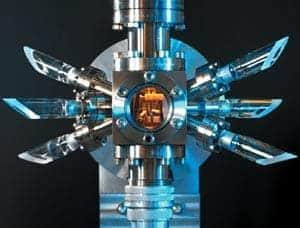
A clock accurate enough for day-to-day use could still be too imprecise for researchers. Optical atomic clocks are based on the idea of how much time can be measured using atoms and light. This technology proves that the definition of a second is still being studied.
How do They Work?
An atomic clock uses the frequencies of atoms in certain compounds to measure time. Other atomic clocks use microwaves to measure time with great accuracy.
Optical atomic clocks use higher frequencies of light that are near the speed of visible light. These are like the little marks on a ruler that allow someone to measure something smaller than an inch.
How do Scientists Make it Work?
Since these higher frequencies are so fast, researchers must build machines that can count these oscillations. Physicists also have to figure out which atoms can be used to measure smaller and smaller units of time. According to the National Institute of Standards and Technology, aluminum, strontium, ytterbium are some of the best metals that are proving to be helpful in creating optical atomic clocks. Some of these clocks use ions that are trapped to oscillate. Another way is to use atoms that are held together by laser beams. This forms an optical lattice that keeps the atoms from shaking.
Scientists are now showing that experiments are successful only if the tool used gives an accurate reading, while the researchers also know why they got the numbers they got. A new tool that can measure tiny movements must be tested and understood. This is what researchers did when they modified a global-positioning-system receiver to detect an earthquake 850 miles away.
## The Bottom Line
Researchers create a new type of atomic clock so that they can measure tinier units of time. Optical atomic clocks are proving that the smallest unit of time that has been researched is still small enough to measure. But, every day that passes proves that physicists are working on finding even smaller ones. Scientists are doing that by figuring out a metal or compound that will be used with the right tools to look at time with a microscopic view.