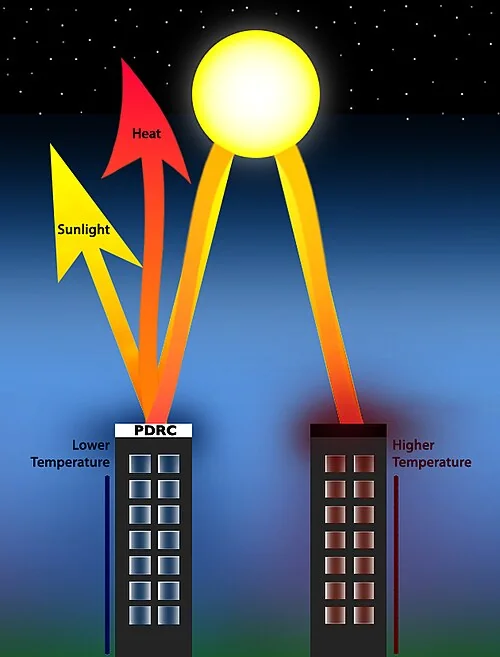
Semiconductor fabrication plants (fabs) and ultra-clean environments require some of the most energy-intensive infrastructures in the modern industrial landscape. The majority of a semiconductor manufacturing facility's energy budget is devoted to HVAC systems for maintaining hyper-precise temperature control ($\pm 0.1^\circ\text{C}$) and managing massive thermal loads from DUV/EUV lithography tools, high-power silicon processing machinery, and large server infrastructure. Semiconductor facility engineers are now looking to Passive Radiative Cooling Coatings (PRCCs) in order to reduce a fab's thermal baseline and cut HVAC power consumption. Reflection of solar radiation and emissivity of heat through Earth's atmospheric infrared window results in sub-ambient surface cooling, without consuming power or water.
1. Thermal Management & Energy Intensity in Semiconductor Fabs
Maintaining ultra-precise cleanroom environments creates critical thermodynamic challenges for semiconductor manufacturing facilities:
Extreme Process Heat Loads: Modern EUV lithography systems and high-density compute infrastructure generate megawatts of waste heat, resulting in massive operational loads on industrial chillers and heat exchangers.
Solar Heat Gain on Fab Roofs: Large footprint cleanroom facilities absorb gigajoules of solar radiation per day across large roof surfaces, increasing ambient thermal stress and building cooling demand.
Strict Thermal Stability Requirements: Even minor temperature fluctuations within lithography bays can induce thermal expansion in silicon wafers or optical components, resulting in critical overlay alignment errors and loss of yield.
2. Radiative Physics & Material Architecture of PRCCs
Passive radiative cooling utilizes tailored optical properties in two spectral regions to achieve sub-ambient surface cooling:
Solar Band Spectrum Reflection ($0.3\text{--}2.5\,\mu\text{m}$): PRCCs utilize high bandgap dielectric nanoparticles (such as silicon dioxide, barium sulfate, or titanium dioxide) suspended in fluoropolymer matrix binders to reflect $>95\%\text{--}98\%$ of incoming solar radiation, preventing solar heat absorption.
The Atmospheric Transparency Window ($8\text{--}13\,\mu\text{m}$): The earth's atmosphere is transparent to infrared light in the $8\text{--}13\,\mu\text{m}$ band. PRCC materials are engineered to maximize emissivity in this spectral window, radiating thermal energy through the atmosphere and out into deep space ().
Sub-Ambient Surface Cooling: By emitting more thermal energy into space than they absorb from solar radiation and ambient air, PRCC surfaces can achieve sub-ambient temperatures, dropping surface conditions $4^\circ\text{C}\text{--}12^\circ\text{C}$ below ambience under direct sunlight.
3. Coating Microstructure & Chemical Scalability
Engineered coatings must maintain optical performance while withstanding harsh environmental and industrial conditions over long lifetimes:
Randomized Microporous & Nanocomposite Matrices: Embedding polydisperse dielectric micro/nanoparticles in polymer matrices maximizes Mie scattering across the solar spectrum, achieving high reflectance without requiring costly multi-layer nanofabrication.
Hydrophobic & Self-Cleaning Functionalization: Fluoropolymer binders (such as PVDF or FEVE) provide superhydrophobic surface properties (), preventing dust accumulation, organic fouling, and moisture adsorption which would degrade infrared emissivity.
Chemical & Thermal Resilience: Industrial grade PRCC formulations are resistant to UV degradation, acid rain, atmospheric ozone, and chemical exhaust from fab cleanroom scrubbers.
4. Facility Deployment, Energy Offset & Sustainability Roadmaps
Integration of passive radiative cooling into semiconductor manufacturing infrastructure presents a number of energy and operational benefits:
Chiller Load Reduction: Application of PRCCs to fab roofs and external HVAC ducting leads to significant reduction in peak roof temperatures, reducing thermal heat gain and lowering chiller energy consumption by $10\%\text{--}20\%$ during peak summer loads.
Condenser Coil Efficiency Gains: Coating external chiller condenser coils and cooling tower housings with conductive radiative coatings improves heat dissipation rates, increasing coefficient of performance (COP) in cooling equipment.
Water Conservation: By reducing total reliance on evaporative cooling towers, PRCC integration conserves millions of gallons of cooling water per year in arid semiconductor manufacturing hubs, while lowering Scope 2 carbon emissions.
Sources
- Wikimedia Commons. (2026). Diagram demonstrating the mechanism of passive daytime radiative cooling (PDRC) [Diagram]. Wikipedia. https://en.wikipedia.org/wiki/Passive_daytime_radiative_cooling