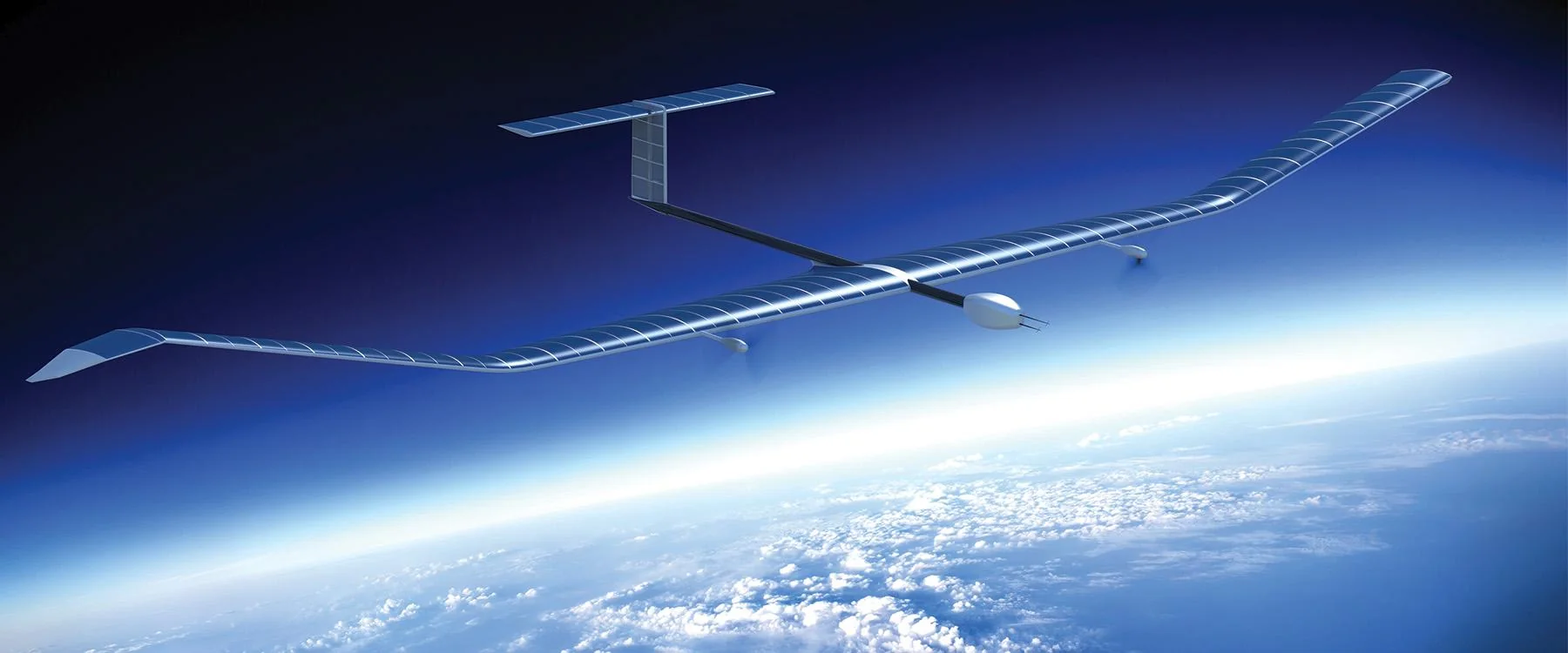
High-Altitude Pseudo-Satellites (HAPS)—unmanned solar-electric aircraft designed to operate at 60,000–70,000 feet—can provide persistent telecommunication, Earth observation, and emergency response services at a small fraction of the multi-million dollar cost of Low Earth Orbit satellites. But in order to stay aloft for weeks or months at a time, such airplanes need to rapidly gather sufficient solar power for active radio payloads while simultaneously topping up energy-dense battery banks for night operations.
Single-junction silicon or III-V GaAs cells are either approaching theoretical efficiency limits or too costly for large-area integration on a HAPS wing. To overcome this, aerospace engineers are looking to Perovskite-Silicon Tandem Photovoltaics to capture multiple regions of the solar spectrum for enhanced power-to-weight performance and extreme power densities () in the thin atmosphere.
1. Solar Energy Collection Challenges for Stratospheric Aircraft
The ability to continuously operate an unmanned aircraft in the stratosphere imposes unique thermodynamic and energy collection constraints:
Weight Optimization: Ultra-light airframes leave little room for conventional glass encapsulated solar cells; every superfluous gram on the wings reduces the useful payload and battery storage capacity of the HAPS.
Diurnal Power Management: Solar platforms must collect extra power during limited winter daylight periods or at higher latitudes to maintain active radio payloads and wing anti-ice heating through the long night.
Thermal and UV Endurance: Photovoltaic arrays at 20 km altitude must withstand huge temperature variations ($+40^\circ\text{C}$ to below $-70^\circ\text{C}$), intense UV flux, and ozone layer chemical etching.
2. Perovskite-Silicon Tandem Cells for High Power Density Solar Arrays
Perovskite-silicon tandem photovoltaics offer a pathway to record-breaking power densities for stratospheric aircraft through dual band-gap absorption and mechanical integration:
Exceeding Single-Junction Limits: Tandem architecture allows exceeding the Shockley-Queisser single-junction limit by $30\%$.
Dual-Band Spectrum Absorption: A wide band-gap perovskite cell () on top of a silicon cell () absorbs high- and low-energy photons, respectively.
High Efficiency Architecture: Monolithic 2-terminal designs enable $>30\% - 33\%$ conversion efficiencies (vs. $\approx 29\%$ for single-junction Si).
Flexible Substrates: Lightweight flexible substrates enable high specific power densities using ultra-thin silicon wafers ($<100\,\mu\text{m}$) or polymer foils.
3. Stratospheric Environment Survivability for Metal-Halide Perovskite Tandems
Adapting perovskite-silicon tandem photovoltaics for HAPS requires overcoming extreme environment hurdles not encountered in terrestrial applications:
UV and Photostability Passivation: Modern 2D/3D heterostructures use halide-passivated perovskites and inorganic barriers to resist UV-induced phase separation.
Flexible Encapsulation: Special polymer foils with optimized coefficients of thermal expansion (CTE) minimize cracking during the huge temperature swings of a 20 km altitude flight.
High-Altitude Radiation Resistance: Metal-halide perovskite crystal lattices exhibit self-healing properties under ionizing radiation for enhanced stability versus conventional silicon.
4. Commercial HAPS Applications for 5G/6G NTN and Extended Range Telecommunication Payloads
Integrating high-efficiency tandem photovoltaics on a commercial HAPS platform fundamentally changes the value proposition of such aircraft by enabling:
Persistent 5G/6G NTN Cell Tower Services: Higher power telecommunication payloads can be supported due to increased solar conversion efficiency.
Extended Latitudinal Envelope and Year-Round Operations: Accelerated battery charging from morning sun enables operating closer to the poles and through longer nights.
Optimized Airframe Economics: Improved power density reduces overall wing area, lowering aircraft weight and enabling shorter take-off/landing distances.
Lower Cost vs. Conventional III-V GaAs Space-Grade Solar Cells: While triple-junction GaAs cells offer exceptional efficiency (), their high manufacturing cost limits their application on a large-scale fleet of HAPS aircraft. Perovskite-silicon tandems can be produced using lower-cost high-throughput printing methods and conventional silicon wafer processing.
Sources
- Holden, W. S. (2023, February). Artist concept of a solar-electric Airbus Zephyr high-altitude pseudo-satellite flying at high altitude above Earth's atmosphere [Digital artwork]. U.S. Naval Institute Proceedings, 149(2). https://www.usni.org/magazines/proceedings/2023/february/high-altitude-pseudo-satellites-are-ready-launch