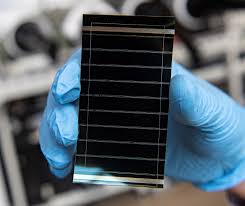
Enhancing solar technology is not only about discovering new locations for panel installation; scientists try to understand how to get more electricity from existing photovoltaic cells by studying their materials. For example, perovskite solar cells are a type of experimental photovoltaic cells that may provide an alternative way of generating more power.
What Are Perovskites?
A mineral called perovskite refers to a group of materials with a similar crystal structure; however, scientists managed to discover a type of metal-halide perovskite that can be utilized as a light-absorbing layer of a solar cell. They state that perovskite solar cells have a much thinner active layer compared to standard crystalline-silicon cells.
The unique properties of this mineral are significant for the modern world because they allow the creation of photovoltaic cells with high efficiency and low production cost.
However, having a product with extraordinary characteristics is not enough for it to become commercially successful.
Stacking Solar Cells: More Layers, More Energy?
The researchers try to make the most of these properties by combining them with materials that absorb light at different wavelengths. The Department of Energy notes that perovskite solar cells can be used in a tandem with another type of photovoltaic cells.
Such a design would allow to reach higher efficiency than a single-junction cell, according to the Energy Department. Stacking solar cells is similar to assigning two people to complete a task that one person could do.
While it might take more time to explain the details of the work to two people instead of one, the final outcome may be better than if it were assigned to one, not prepared person. In this case, the best option would be choosing the one that would cope with the given task faster. Similarly, tandem solar cells would be able to utilize the incident light better than a single photovoltaic cell.
## Efficiency, Lifetime, and Cost: The Main Focus of Researchers
The Energy Department states that scientists and manufacturers are working together to improve solar cells’ power conversion efficiency, lifetime, and cost. The overview also mentions that, before commercialization, there are several issues to resolve.
Therefore, even if the efficiency of such solar cells is very high in laboratory conditions, it would not be enough for it to become commercially successful.
A product would need to be tested for its ability to withstand the conditions it would have to operate in.
To conclude, perovskite solar cells illustrate the importance of scientific research into materials and their properties. The main point is that, for a photovoltaic cell to become commercially viable, it has to be highly efficient and operate for a long time after installation. Scientists and manufacturers should work together to make the product both high-quality and affordable in order for it to be successful on the market.