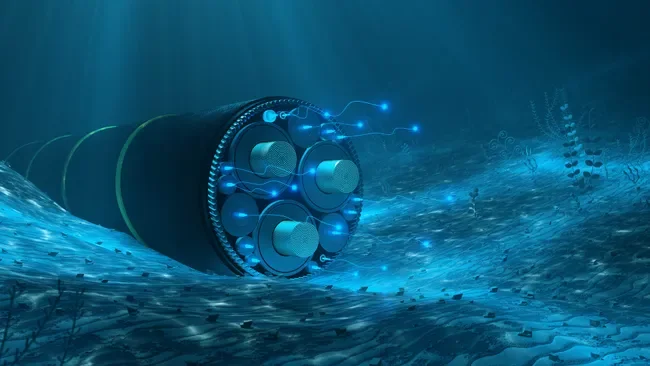
The growing demand from distributed AI clusters, cloud providers, and video platforms for bandwidth-hungry transcontinental data centers has strained current infrastructures of information exchange to their physical limits. The capacity of traditional transatlantic fiber-optic cables is already stretched to the maximum due to power distribution and nonlinear optical interference constraints in single-mode fibers (SMF). To meet Petabit-scale international traffic demands, the subsea optical infrastructure now looks toward Space Division Multiplexing (SDM) and higher-power optical amplifiers. Meta and SubCom’s petabit-class repeater cables use multi-core fibers and power-efficient pump-sharing architectures to reach an unprecedented level of capacity per unit of power.
1. Physical & Electrical Limitations of Current Subsea Infrastructure
When installing high-performance, long-haul (>5,000 km) fiber infrastructure on the seabed, designers face significant power and physical design constraints:
Nonlinear Limits in Single-Mode Optical Waveguides: The higher the optical power launched into the waveguide core, the higher the level of Kerr nonlinearity at a given signal-to-noise ratio (SNR).
Limited Electrical Power Feed from On-Shore Power Feeding Equipment (PFE): The electrical power supplied to deep-sea repeaters is limited by the voltage drop along the power feed conductor, which is currently constrained to 18 kV.
Cable Mechanical Limitations: Increasing the number of single-mode fiber pairs per cable enlarges the physical cross-section of the optical cable, making installation, vessel handling, and maintenance significantly more challenging.
2. Silicon & Optical Innovations: SDM, Multi-Core Fibers & Optical Repeaters
Petabit international cables use Space-Division Multiplexing (SDM) and novel pump-sharing optical amplifiers to reach higher power efficiency and spatial throughput density than their single-mode fiber predecessors:
Space Division Multiplexing (SDM) & Multi-Core Fiber: Instead of relying exclusively on single-core optical fibers, petabit subsea systems utilize multi-core single-mode fibers to increase the number of spatial channels per cable. By doubling the number of cores per fiber while maintaining the standard 125μm outer cladding diameter, cable capacity scales without increasing physical bulk.
Pump-Sharing Erbium-Doped Fiber Amplifiers (EDFA): Modern petabit-class subsea repeaters utilize high-efficiency EDFA configurations. Instead of using separate laser diode pumps for each individual amplified channel, high-power uncooled laser diodes are shared across multiple channels using advanced pump-sharing technology.
C+L Band Uncompressed Spectrum: To maximize the transmission capacity of petabit repeater systems, engineers utilize the extended Wavelength Division Multiplexing (WDM) optical domain. By extending the amplification range into the L-band alongside the standard C-band, each spatial channel can carry twice as much information.
3. Power Efficiency & Signal Integrity in Long-Haul Subsea Repeaters
A petabit repeater system must maintain the required optical signal-to-noise ratio (OSNR) over long transoceanic spans (6,000–14,000 km). Each SDM channel is constructed to maximize power efficiency while suppressing inter-channel interference:
Core Spacing and Trench-Assisted Design: Optimized inter-core spacing and refractive index engineering in multi-core fibers keep inter-core crosstalk at a minimal level, preserving clean high-baud-rate channels (>120 GBd).
Low-Power-Density Operation: To achieve maximum overall power efficiency, multi-core SDM systems operate each channel at a lower power density than traditional single-mode fiber systems. Lower optical power density reduces nonlinear Kerr interference, allowing for far more efficient utilization of total launched power.
Coherent Digital Signal Processors (DSPs): At the receiving terminals, coherent transponders leverage high-baud DSPs with probabilistic constellation shaping (PCS) and soft-decision forward error correction (SD-FEC) to dynamically adjust data rates and coding efficiency based on real-time channel noise characteristics.
4. Transoceanic AI Infrastructure Distribution & Future Networks
Petabit infrastructure represents the physical foundation for next-generation international communications, unlocking scalable, distributed AI infrastructure across continents:
AI Distributed Training & Cloud Synchronization: Petabit-scale subsea cable systems allow for high-throughput exchanges of gradient information and continuous model weight synchronization between distributed AI clusters located on different continents.
Network-Level Reliability & Fault Tolerance: Providing petabit-scale connectivity between global hubs via novel SDM systems is essential for ensuring the uninterrupted operation and fault-tolerant rerouting of the global Internet backbone.
Subsea Telecom Infrastructure Compatibility: Because SDM petabit systems operate strictly within the 18 kV power envelope of traditional PFEs, 2-core and high-pair SDM cables can be deployed using existing subsea cable-laying fleets without requiring a complete overhaul of global marine installation equipment.
Sources
- Haslam, O. (2026, September 23). Cross-section rendering of a high-capacity armored subsea fiber-optic cable resting on the ocean floor [Digital artwork]. Tom's Hardware. https://www.tomshardware.com/networking/metas-new-transoceanic-undersea-cable-boasts-a-whopping-petabit-of-bandwidth-petal-link-between-us-and-france-will-be-twice-as-fast-as-the-last