Phase-Change Thermal Storage: Saving Heat by Melting a Material
Ice absorbs heat while melting even though its temperature changes little during the transition. Engineers can use the same general principle with materials selected for other temperature ranges. Phase-change thermal storage uses melting and solidification to hold energy until a more useful time.
What is being stored?
DOE defines thermal energy storage as reserving energy in a material that can later act as a heat source or a cold sink. In a phase-change material, often called a PCM, much of the useful storage comes from the energy absorbed or released during a change of state. This is known as latent heat.
A building-related DOE research project explains that a PCM can melt as it absorbs heat during a warmer period and solidify as it releases heat later. The material has to be selected so that its transition occurs in a useful temperature range. Otherwise, it may stay in one state and provide little of the intended benefit.
A daily cycle
Imagine a demonstration room containing panels designed to absorb some afternoon heat. If the material melts during that period and solidifies during a cooler period, it can help shift when heat is absorbed and released. This hypothetical example depends on a suitable daily temperature pattern; the panels do not automatically repeat the useful cycle under every weather condition.
A project team would want to know whether the material actually resets between cycles. It would also compare room temperatures and equipment demand over many days, rather than drawing a conclusion from one comfortable afternoon. The key question is how the material behaves within the whole building.
Packaging is part of the technology
DOE’s multipurpose latent-heat project investigates salt-hydrate materials and their encapsulation. It identifies challenges including subcooling, changes during repeated melting, and separation of material components. The container and heat-transfer design therefore matter alongside the chemistry.
Subcooling illustrates why a simple melting-point label is incomplete. A material’s freezing behavior may not match an idealized expectation, making it harder to release stored heat at the desired time. Repeated cycling also needs to be evaluated rather than assumed.
A material can have impressive storage capacity and still exchange heat too slowly for a particular task. The design needs to connect stored energy with the room, fluid, or equipment that will use it. This is a system-design issue, not just a search for the material with the largest headline number.
Benefits and limits
Thermal storage can shift heating or cooling demand, but it does not create new energy. Its usefulness depends on when energy is available and when it is needed. The cost, durability, packaging volume, and appropriate operating temperatures all influence the result.
Summary
Phase-change storage uses latent heat to hold and release thermal energy. Its promise lies in useful timing: absorbing energy in one period and delivering the thermal effect in another. Suitable temperatures, repeatable cycling, and effective heat transfer determine whether that promise becomes practical.
Works Cited
U.S. Department of Energy. “Thermal Energy Storage.” n.d. Accessed 10 Oct. 2026.
U.S. Department of Energy. “Multipurpose Latent Heat Storage System for Building Applications.” 24 Mar. 2021. Accessed 10 Oct. 2026.
Suricata. “Handwaermer12.” Wikimedia Commons, n.d.. Image. CC BY-SA 3.0. Accessed 10 Oct. 2026.
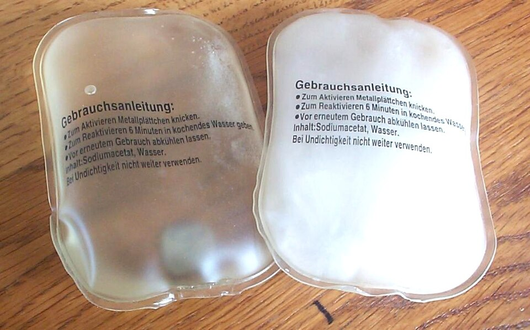
Reusable heat packs illustrate latent heat release during a phase change. Image: Suricata; CC BY-SA 3.0.