Precision Fermentation: Making Food Proteins with Microorganisms
Fermentation is familiar from foods such as yogurt and bread. Precision fermentation uses microorganisms for a more targeted manufacturing task: producing a selected ingredient. For alternative proteins, that can mean making a particular food protein in a controlled production process.
Different roles for microorganisms
The Good Food Institute distinguishes traditional fermentation, biomass fermentation, and precision fermentation. Traditional fermentation changes a food. Biomass fermentation uses the microorganisms themselves as a protein-rich ingredient. Precision fermentation focuses on a specific molecule produced by the organism.
This distinction helps avoid treating every fermented food as the same technology. The desired output determines the production design and the work needed afterward. Growing cells is only part of making a finished ingredient.
From production culture to purified ingredient
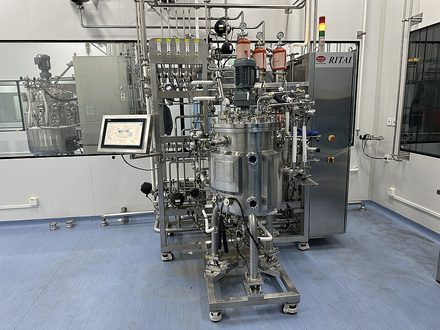
GFI’s value-chain documentation describes organisms, growth media, bioreactor operation, and downstream processing as connected parts of the system. Feedstocks supply the resources for growth and production. The product then has to be separated or processed into a usable form.
A concrete FDA record for a beta-lactoglobulin ingredient describes precision fermentation with a production strain of Aspergillus oryzae. The manufacturer’s described process includes separating biomass from broth, purifying the protein, and drying the final material. The cited letter documents that particular ingredient and process; it is not a blanket conclusion about all fermentation-made foods.
An illustrative product-development question
Imagine a food developer comparing a fermentation-made protein with an established ingredient in a recipe. The team would assess the behavior it needs: perhaps texture, solubility, or performance during heating. It would also examine whether the ingredient remains consistent across production batches.
This hypothetical comparison is more useful than asking whether the new ingredient is simply “the same” or “different.” A protein’s identity, purity, handling, and behavior in a food all contribute to its practical role. The final recipe still needs to work for its intended use.
Costs and environmental claims
The production process requires feedstocks, equipment, controlled conditions, and downstream handling. Any claim about cost or resource savings should account for those stages. A laboratory yield should not automatically be treated as the performance of a full industrial plant.
The same care applies to environmental comparisons. A meaningful assessment identifies what product and production route are being compared and includes relevant operating inputs. The term “animal-free” describes one aspect of the process; it does not establish every property of the finished food or its entire environmental footprint.
Summary
Precision fermentation uses selected microorganisms to manufacture particular ingredients, including food proteins. Its practical promise rests on the complete process from culture to purified product. Reliable quality, useful food functionality, production cost, and clear process-specific evidence determine its value.
Works Cited
The Good Food Institute. “Fermentation.” n.d. Accessed 10 Oct. 2026.
The Good Food Institute. “Value Chain: Fermentation.” n.d. Accessed 10 Oct. 2026.
U.S. Food and Drug Administration. “GRAS Notice 1145: Agency Response Letter.” n.d. Accessed 10 Oct. 2026.
Habin Zhang. “Bioreactor in operation.” Wikimedia Commons, 6 March 2023. Image. CC BY-SA 4.0. Accessed 10 Oct. 2026.
A bioreactor used to cultivate microorganisms. Image: Habin Zhang; CC BY-SA 4.0.