
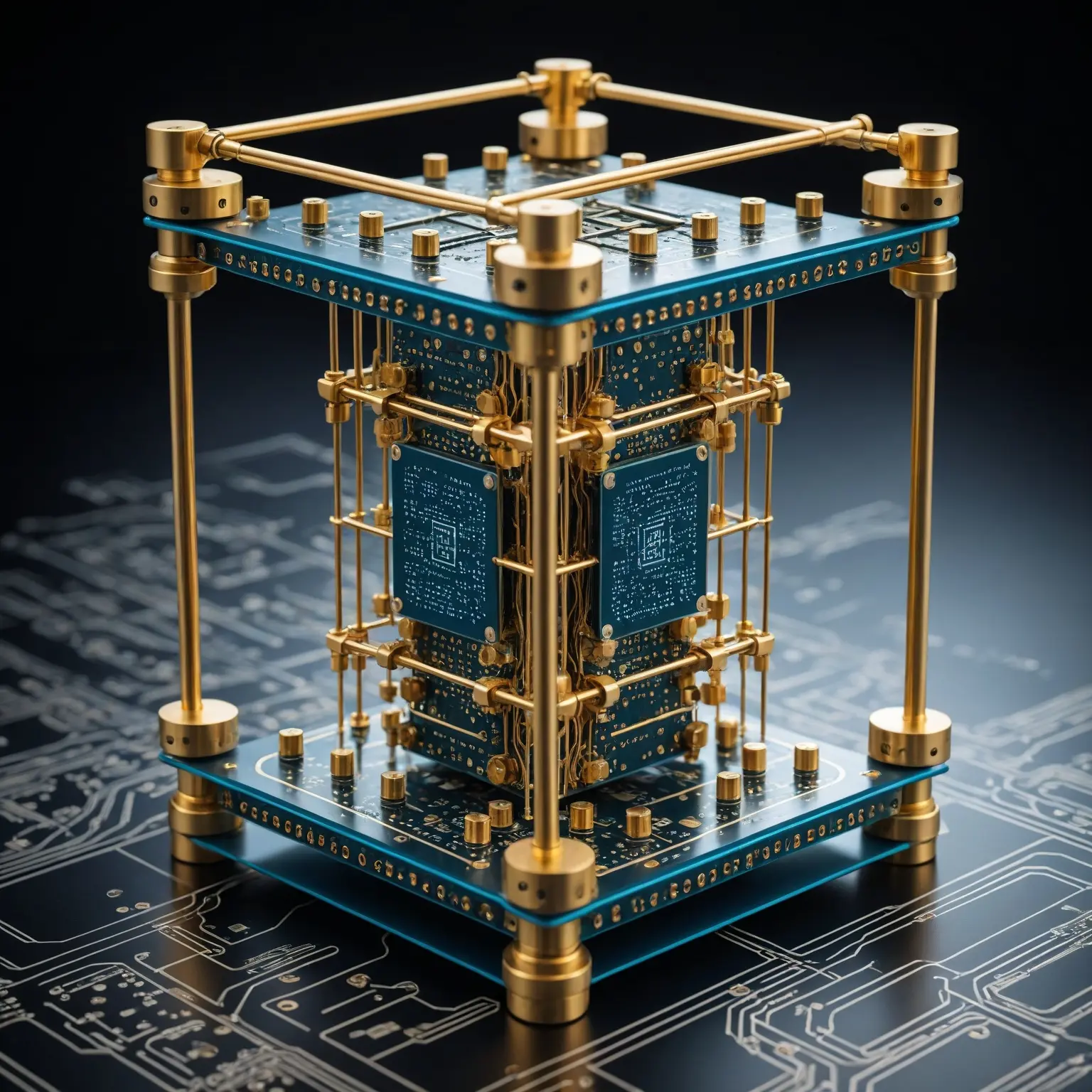
Quantum processors are commonly compared by their number of physical qubits. That measure is easy to communicate and increasingly incomplete. A useful machine must execute long sequences of gates without noise overwhelming the answer, and today's physical qubits are far too fragile for many proposed applications.
Quantum error correction is the mechanism intended to close that gap. It encodes one logical qubit across many physical qubits, repeatedly measures error syndromes without directly measuring the protected state, and uses a classical decoder to infer corrections. The central question is whether adding redundancy reduces the logical error rate faster than it introduces new failure opportunities.
Below Threshold Is the Essential Transition
An error-correcting code has a threshold. Above it, a larger code makes performance worse because extra qubits and gates add more faults than the code can handle. Below it, increasing code distance can suppress logical errors exponentially. Crossing that boundary converts scale from a liability into an asset.
Google reported that transition in December 2024 with Willow, describing it as “the first quantum processor where error-corrected qubits get exponentially better as they get bigger” (Google Quantum AI). Its peer-reviewed surface-code experiment compared distance-3, distance-5, and distance-7 memories. The 101-physical-qubit distance-7 code reached a 0.143 percent error per correction cycle, and increasing distance by two suppressed logical errors by a factor of 2.14. The logical memory lasted 2.4 times longer than its best constituent physical qubit (Nature).
That was a landmark, not a finished computer. The experiment protected memory rather than executing a large, universal algorithm. It also observed rare correlated events that created an error floor in repetition-code tests. Such events matter because error-correction theory often begins with simplified assumptions about independent noise, while real devices experience leakage, radiation, calibration drift, crosstalk, and shared-control failures.
Hardware Platforms Face Different Tradeoffs
Superconducting systems offer fast gates but require correction cycles and classical decoding on microsecond timescales. Trapped ions operate more slowly but can achieve high-fidelity gates and flexible connectivity. Neutral atoms can rearrange large arrays and apply operations in parallel. Bosonic or “cat” qubits attempt to suppress one error type in hardware so that the outer code has less work to do.
Microsoft and Quantinuum demonstrated four logical qubits on trapped-ion hardware in 2024, reporting logical-versus-physical improvements as high as 800-fold and more than 14,000 experimental runs without an observed error (Microsoft). Some results used error detection and post-selection, however, which discards runs and cannot be treated as equivalent to deterministic fault-tolerant computation. Their September 2024 follow-up created and entangled 12 logical qubits, illustrating progress toward logical circuits rather than isolated memories (Microsoft).
Researchers are also redesigning the physical qubit around correction overhead. AWS reported that conventional approaches can increase qubit counts by roughly 1,000 times on error-prone hardware. Its dual-rail experiments convert some otherwise silent faults into flagged erasures, which are easier for a decoder to locate (AWS Center for Quantum Computing). This is hardware–software co-design: the most valuable physical qubit may not have the best isolated headline metric, but the noise structure that produces the cheapest reliable logical qubit.
The Remaining Bottleneck Is a Stack
Logical memory is only one layer. A fault-tolerant machine also needs reliable logical gates, state preparation, measurement, routing, and reset. Non-Clifford operations used for universal computation can require expensive “magic-state” factories. Decoders must keep pace with syndrome data, and control electronics must operate without injecting correlated noise. Fabrication yield, cryogenic wiring, calibration, and modular interconnects all constrain scale.
This makes physical-qubit totals a poor basis for comparing roadmaps. More informative measures include error per logical cycle, suppression factor as code distance grows, physical qubits per logical qubit at a stated target error, decoder latency, leakage handling, and the number of logical operations completed before failure. IBM's development roadmap, for example, separately tracks circuit quality, real-time decoding, and a long-term goal of thousands of logical qubits rather than presenting physical scale alone (IBM Quantum).
A Better Test for Quantum Progress
Error correction concentrates the field's hardest problems into one measurable requirement: can a system perform more reliable computation by becoming larger? It forces hardware, cryogenics, control, algorithms, and classical processing to work as one system.
The recent experiments show that the underlying principle works across several architectures. They do not establish how quickly it can be manufactured at useful scale or at acceptable cost. Investors and policymakers should therefore reward reproducible logical performance, complete resource estimates, and demonstrations that include computation—not just memory or post-selected runs.
Quantum error correction is a bottleneck in the productive sense. Passing through it would turn physical qubits into an engineering resource for dependable computation. Until then, raw qubit count mostly describes the size of the noisy machine, not the amount of reliable work it can do.
Sources
- Nature — Quantum Error Correction Below the Surface Code Threshold
- Google Quantum AI — Making Quantum Error Correction Work
- Microsoft — Logical Qubits on Quantinuum Hardware
- AWS Center for Quantum Computing — A New Building Block for Error-Corrected Quantum Computers
- IBM Quantum — Development and Innovation Roadmap
- Nature — Logical Quantum Processor Based on Reconfigurable Atom Arrays