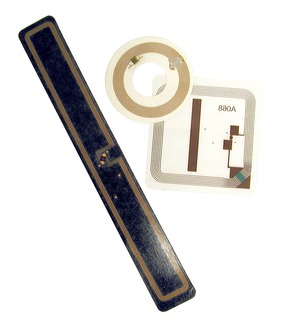
A barcode usually has to be visible to a scanner. What if a system needs to identify a tagged object through a radio exchange instead? Radio-frequency identification, or RFID, links an electronic tag with a reader. It can help turn the movement of physical objects into records that a computer can process, but the tag's identity and the meaning of its record remain separate questions.
Tags, Readers, and Identifiers
GS1 explains that RFID systems can use electronic product codes to identify objects. Those identifiers have representations suitable for tags and for information systems. Radio signals can capture identifiers without the same line-of-sight requirement as a visible barcode.
RFID is a family of arrangements rather than one universal tag design. GS1 distinguishes active tags, which have a transmitter and typically their own power source, from passive tags that obtain operating energy from the reader and return information by modifying the reflected signal.
Think of a storeroom containing boxes with individual tags. A reader could help staff determine which tagged objects are present in a particular reading area. The hypothetical advantage is easier identification; the computer still needs an accurate association between each identifier and the box it represents.
The Complete System Matters
NIST's Guidelines for Securing Radio Frequency Identification Systems describes a system that includes radio components and the processing of information. The guidance examines risks such as unauthorized reading and the protection of information associated with tags.
That perspective is important because the tag itself may contain only part of the useful record. A captured identifier can be linked to information elsewhere, where access and accuracy need their own consideration. A system that reads a tag reliably can still display an incorrect description if its records are wrong.
For the storeroom, staff would need procedures for attaching a tag to the right item and updating the association when an item changes. The collection would also need a clear definition of what a successful read means.
A Read Is an Observation
Suppose a tagged box appears in a reader's range near a doorway. Does the record prove that the box entered the room, left it, or simply passed nearby? The answer depends on the reader arrangement and the way the software interprets its observations.
This example shows why an identification mechanism should be tested in the actual workflow. The desired result is an accurate inventory event, rather than merely a list of tag responses. People designing the system should connect the reading area, identifier, and operational rule.
Summary
RFID connects tagged physical objects with digital identifiers through radio communication. Its value comes from making identification easier in suitable conditions. A reliable application combines the right tags and readers with accurate records, controlled access, and a clear interpretation of what each observed tag response establishes.
Works Cited
GS1. “RFID.” n.d. Accessed 10 Oct. 2026.
GS1. “What Is the Difference between Passive and Active Tags?.” 30 Aug. 2024. Accessed 10 Oct. 2026.
National Institute of Standards and Technology. “Guidelines for Securing Radio Frequency Identification Systems.” Apr. 2007. Accessed 10 Oct. 2026.
Grika at English Wikipedia. “RFID Tags.” Wikimedia Commons, 30 March 2006 (original upload date). Image. CC BY 2.5. Accessed 10 Oct. 2026.
RFID tags used for library materials. Image: Grika at English Wikipedia; CC BY 2.5.