Seismic Base Isolation: Giving a Building Room to Move
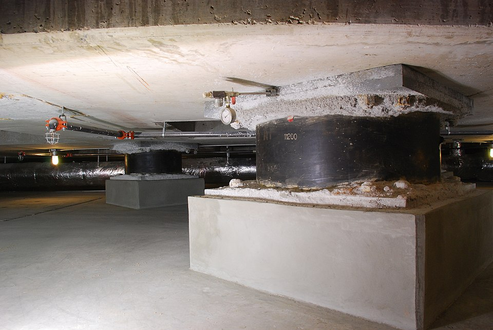
A building normally follows the movement of the ground beneath it. Seismic base isolation changes that connection. Special components near the base support the structure while allowing controlled relative motion, reducing some of the shaking transmitted upward.
What is isolated?
USGS describes base isolation as partially decoupling a building from earthquake ground motion. The building remains supported, but the connection is designed to behave differently from a conventional rigid foundation arrangement.
FEMA’s rehabilitation guidance explains that isolation lengthens a building’s fundamental vibration period to reduce seismic demand. Elastomeric bearings and sliding bearings are examples of isolation components. Dampers may also be used to limit displacement.
The word “isolation” does not mean the structure floats freely or becomes immune to earthquakes. The system must carry gravity loads, manage movement, and work with the rest of the building. Its useful behavior depends on the whole design.
Evidence from an actual building
USGS reports measurements from the University of Southern California University Hospital during the 1994 Northridge earthquake. Its base isolators reduced the shaking transmitted to the building, and the recorded response supported the strategy’s effectiveness in that event.
That observation is valuable because it concerns an actual structure under earthquake loading. It still should not be transformed into a guarantee for every isolated building or every future earthquake. The event, site, structure, and isolation design define the context of the result.
An illustrative project assessment
Imagine an engineering team assessing an important archive building. It would need to consider whether the structure and ground conditions are suitable for isolation, how much movement the system must accommodate, and how utility connections cross the moving interface.
This hypothetical assessment would also include the contents. Protecting the main structure is only one part of preserving an archive’s function. Equipment, shelves, and other nonstructural components need to be considered within the complete performance goal.
Limits and testing
FEMA notes that very soft soils and very tall, flexible buildings may receive limited benefit from some isolation arrangements. This shows why the technology cannot be chosen solely because it worked in another project.
NIST research on elastomeric bearings examines how component testing relates to full-scale capacity. A component’s reliable behavior is essential, and a scaled test has to represent the relevant features accurately. Design confidence comes from analysis and evidence suited to the proposed system.
Summary
Seismic base isolation uses flexible or sliding support components to change how ground motion reaches a building. It can reduce damaging response in suitable applications. Its effectiveness depends on site conditions, structural behavior, displacement space, connections, and tested component performance.
Works Cited
U.S. Geological Survey. “Evaluating Earthquake Protection.” 2003. Accessed 10 Oct. 2026.
Federal Emergency Management Agency. “Techniques for the Seismic Rehabilitation of Existing Buildings, FEMA 547.” n.d. Accessed 10 Oct. 2026.
Bradley, G. L., P. Chang, and A. W. Taylor. NIST. “Determination of the Ultimate Capacity of Elastomeric Bearings under Axial Loading.” 1 Feb. 1998. Accessed 10 Oct. 2026.
Mike Renlund. “Base isolators under the Utah State Capitol.” Wikimedia Commons, 17 April 2008. Image. CC BY 2.0. Accessed 10 Oct. 2026.
Seismic base isolators beneath the Utah State Capitol. Image: Mike Renlund; CC BY 2.0.