Self-Healing Concrete: Sealing Small Cracks from Within
A small concrete crack can become a pathway for water and other substances. Repairing every developing crack from the outside is difficult. Self-healing concrete research asks whether a material can contain an internal response that helps seal damage when it appears.
A biological approach
The University of Bath describes research that adds bacterial spores and growth media to concrete. When cracking exposes the system to suitable conditions, bacterial activity can produce calcium carbonate. This mineral can help fill a crack.
The idea does not involve concrete thinking about its condition. It is a designed response involving organisms, nutrients, water, and the surrounding material. The required conditions and the amount of damage influence whether the response is useful.
Why the bacteria need protection
Bath research on expanded perlite investigates carriers that protect bacteria-based healing agents. The carrier is important because the agents must survive the material’s preparation and remain available when cracking occurs. Introducing an active ingredient is only one part of the engineering problem.
Another Bath study evaluates air-entraining admixtures as a possible protection method for bacterial spores. It considers healing of cracks formed at different ages and identifies encapsulation cost as an obstacle to commercialization. This makes timing and economics part of the research, alongside visible crack closure.
What does “healed” mean?
A crack looking smaller is useful evidence, but it is not the same as proving that every original structural property has returned. A study might evaluate sealing, water transport, or another particular measure. Readers should look for the specific outcome rather than treating the word “healing” as a complete performance guarantee.
Imagine a test program comparing ordinary concrete panels with panels containing healing agents. The researchers could introduce controlled cracks and record the conditions under which the specimens are stored. They would then measure the property they want to improve, rather than relying only on photographs. This is an illustrative testing approach, not a description of a particular experiment.
Benefits and limits
The attraction is improved durability with less intervention for suitable damage. If a material can reduce pathways for water or aggressive substances, it may help a structure retain useful serviceability. But the approach must fit the crack sizes, exposure conditions, and material behavior being addressed.
A project also needs evidence about the effects of additives on concrete before damage occurs. Mixing, setting, strength, and long-term performance remain important. A promising healing response would not justify overlooking the requirements of the original material.
Summary
Bacteria-based self-healing concrete seeks to use mineral formation inside cracks as a built-in repair response. The research combines biological activity with material protection and testing. Its practical value depends on what kind of damage it addresses and which performance benefits are demonstrated over time.
Works Cited
University of Bath. “Using Bacteria to Create Spontaneous Self-Healing Concrete.” n.d. Accessed 10 Oct. 2026.
Tan, Linzhen, Kevin Paine, and Veronica Ferrandiz-Mas. “Application of Perlite as Encapsulation Carrier for Bacteria in the Self-Healing Concrete.” n.d. Accessed 10 Oct. 2026.
Reinoso, Ismael Justo, et al.. “Air-Entraining Admixtures as a Protection Method for Bacterial Spores in Self-Healing Cementitious Composites: Healing Evaluation of Early and Later-Age Cracks.” n.d. Accessed 10 Oct. 2026.
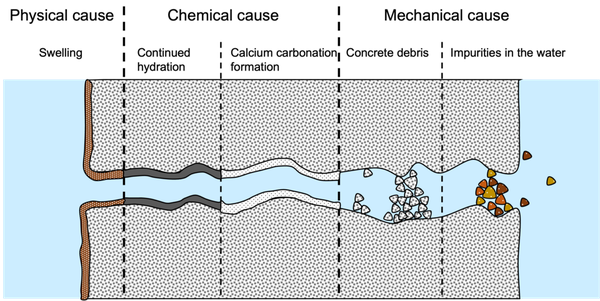
Niranjan Prabhu K. “Autogenous self-healing mechanism.” Wikimedia Commons, 5 July 2022. Image. CC BY-SA 4.0. Accessed 10 Oct. 2026.
Published illustration of autogenous crack healing in concrete. Image: Niranjan Prabhu K; CC BY-SA 4.0.