Small Modular Reactors: What Modularity Changes in Nuclear Power
A large power project can be difficult to build and finance all at once. Small modular reactors, or SMRs, propose a different scale and manufacturing approach. The central idea is to combine a smaller reactor unit with greater use of repeatable, factory-made components.
What “modular” means
DOE explains that major components of the nuclear steam-supply system can be fabricated in a factory and shipped to the site. The goal is to reduce some of the extensive on-site assembly required by a conventional large project. Multiple units may also offer flexibility in how capacity is added.
Modularity does not mean a complete power plant can be placed anywhere without supporting infrastructure. Site preparation, connections, operating arrangements, and the systems around the reactor still matter. Factory manufacture changes part of the construction process; it does not eliminate the rest.
A family of designs
The Nuclear Regulatory Commission’s backgrounder discusses both water-cooled SMRs and advanced designs using other coolants. The label therefore covers different reactor concepts. Their fuel, heat-transfer arrangement, and safety features need to be evaluated individually.
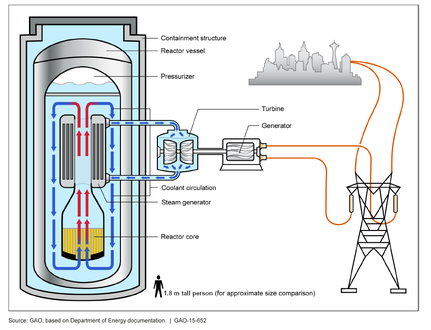
The general energy-conversion idea is to obtain useful heat from nuclear fission and use an appropriate system to deliver electricity or another intended output. A smaller unit still requires engineered control and heat management. Size alone does not establish its complete performance.
Repetition and manufacturing
Factory production is attractive partly because a repeatable design can support consistent work and accumulated experience. DOE’s discussion identifies potential benefits in construction duration, cost, and quality. Those benefits are aims to be demonstrated through actual production and projects, rather than automatic results of the modular label.
Imagine a utility comparing a multi-unit proposal with other ways to meet an identified need. It would examine when each unit would operate, what shared systems are required, and how the project behaves if only part of the planned capacity is built. This is a hypothetical assessment, not a claim about a particular project’s economics.
Evidence and practical limits
NRC’s backgrounder explains the role of reviewing reactor designs. A design review, a site-specific project, construction, and operation are different stages. Reporting should distinguish these milestones rather than presenting one as proof that all later work is complete.
A realistic assessment also includes fuel supply, trained staff, maintenance, waste management, and the end of the plant’s service life. A lower initial project size is not the same as a proven lower cost for each unit of useful output. The comparison should describe its assumptions and the complete operating system.
Summary
SMRs aim to connect smaller reactor units with modular manufacturing and flexible deployment. Their promise depends on repeatability, reliable construction, and useful operation. The meaningful evaluation is design-specific and includes the whole plant, its site, and its lifetime responsibilities.
Works Cited
U.S. Department of Energy. “Benefits of Small Modular Reactors (SMRs).” n.d. Accessed 10 Oct. 2026.
U.S. Nuclear Regulatory Commission. “Backgrounder on New Nuclear Plant Designs.” n.d. Accessed 10 Oct. 2026.
U.S. Department of Energy. “Small Modular Reactors – Key to Future Nuclear Power Generation in the U.S..” n.d. Accessed 10 Oct. 2026.
U.S. Government Accountability Office. “Illustration of a light-water small modular nuclear reactor.” Wikimedia Commons, 3 August 2015. Image. Public domain. Accessed 10 Oct. 2026.
A published GAO illustration of a light-water small modular reactor. Image: U.S. Government Accountability Office; Public domain.