Software-Defined Radio: Making the Signal Processor Programmable
What if a radio could change much of its behavior without replacing a collection of dedicated circuits? Software-defined radio, often shortened to SDR, moves signal-processing tasks into software. It makes a radio platform more adaptable, while leaving important physical limits in place.
From hardware functions to software blocks
GNU Radio describes itself as a toolkit of signal-processing blocks for building software radios. With suitable radio hardware, it can be used to receive or transmit signals. It can also run simulations without external radio equipment. A processing chain can combine operations such as filtering, modulation, and demodulation.
The general idea is to represent a signal as samples and process those samples with programmed operations. Changing a processing chain can change what the system does. A researcher can compare different approaches without rebuilding every function as a separate physical circuit.
The GNU Radio FAQ explains that its processing blocks are mainly written in C++, with Python commonly used to assemble applications. This division helps connect computationally demanding processing with a flexible development environment. A graphical interface can also help users see the flow of information between blocks.
A classroom example
Imagine students studying how interference affects a simple signal. In a simulation, they could create a source, add a controlled disturbance, and compare the output of different filters. Because the input conditions are repeatable, the class can discuss why one result differs from another.
This example does not require the students to transmit over the air. It shows an important educational benefit: software can make an otherwise invisible signal-processing sequence easier to inspect. A display of samples or frequency content can connect a mathematical operation with a visible result.
Flexibility has boundaries
Software cannot give a radio antenna or front end capabilities that the hardware does not possess. The supported frequencies, usable bandwidth, conversion hardware, and computer
performance still shape what a platform can do. GNU Radio’s documentation makes clear that appropriate hardware and computational resources depend on the application.
There is also a difference between building a working demonstration and maintaining a dependable instrument. A team needs to understand its sample rates, processing assumptions, and measurement chain. A result that looks persuasive on a screen may still reflect a configuration mistake or an unsuitable input.
For a project, a useful first step is to state the required task precisely. Is the goal to understand a modulation method, inspect a received signal, or compare an algorithm? That choice helps determine whether a simulation is enough and what hardware, if any, is necessary.
Summary
Software-defined radio makes signal processing programmable and easier to experiment with. Its power comes from the combination of flexible software and suitable physical equipment. The most useful systems are designed around a clear signal-processing question and an honest understanding of the hardware’s limits.
Works Cited
GNU Radio Project. “About GNU Radio.” n.d. Accessed 10 Oct. 2026.
GNU Radio Project. “Frequently Asked Questions.” n.d. Accessed 10 Oct. 2026.
g7ahn. “Perseus SDR receiver.” Wikimedia Commons, 26 September 2012. Image. CC BY 2.0. Accessed 10 Oct. 2026.
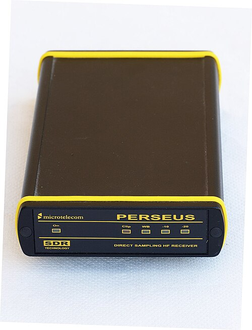
A Perseus software-defined radio receiver. Image: g7ahn; CC BY 2.0.