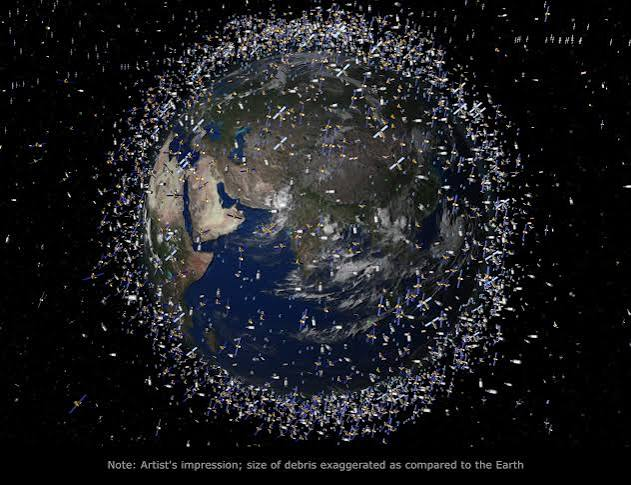
Despite the vastness of space, a zone around the Earth reaches an unacceptable level of congestion due to the objects in orbit. It turns out that the beauty of technology is veiled by the clutter from where it came. The issue of space debris is of such importance to engineers, who must account for the aftermath of their projects.
The article discusses the concerns related to space junk and presents the engineering solutions needed to mitigate the problem.
First of all, it seems reasonable to define what space debris refers to in the article. NASA experts say that orbital debris is a general term for human-made objects in space that no longer have value. The list of such objects is broad — from dead spacecrafts to spent rocket fuel, and even to paint flakes that could damage the equipment in space.
It would seem that the bigger the chunk of space junk is, the more dangerous it is for the spacecraft. “In a low Earth orbit, the average relative speed between colliding objects is 7 to 8 km/s,” NASA notes. The average speed of impact is about 10 km/s; thus, one can imagine the destructive potential of a piece of space junk. Therefore, even a small object can become a big threat if it moves at a high speed.
It is necessary to emphasize that the space debris problem cannot be addressed just through the usual approaches, as one might do it on Earth. For instance, one could not simply take a broom and try to sweep space junk away. Experts argue that this task is complicated by the objects’ various sizes and the fact that “larger objects can be individually tracked” while “smaller objects may only be estimated based on observed density”. Thus, it appears that the engineers should rely on both observation and calculation when researching space junk.
It is also important to note that engineers should make choices when it comes to what space debris to prioritize. NASA experts highlight a dilemma between “the importance of tracking larger objects and the risk posed by smaller objects”. If two objects of different sizes are found, the bigger one would not necessarily be the most dangerous. It would be reasonable to rely on the objects’ projected trajectory and frequency of encounters when determining the threat.
A NASA research study discusses and compares technological solutions to the problem of space debris. The researchers evaluated the “cost-benefit” of different approaches to mitigating the problem. It is argued that NASA considers not only the technology itself but also how much it could potentially reduce the risk.
In this regard, one could suggest that a promising technology does not necessarily mean a technology that is currently available. Experts should carefully consider the options before taking any action. In particular, the space launch projects should be complemented by special
programs for managing space debris. Finally, it is vital to prevent space junk from forming in the first place.
All things considered, the article describes the problem of space debris. In short, it states that debris threatens the objects in space, which, in turn, makes space exploration difficult. Managing space junk is an engineering challenge; therefore, it is better to think through the consequences of space launches to be sure that the projects will not lead to long-term damage to the environment.
Reference
Orbital Debris Program Office. “Frequently Asked Questions.” NASA , 2026.
NASA. “New NASA Report Reframes the Challenge of Addressing Orbital Debris.” , 2026.