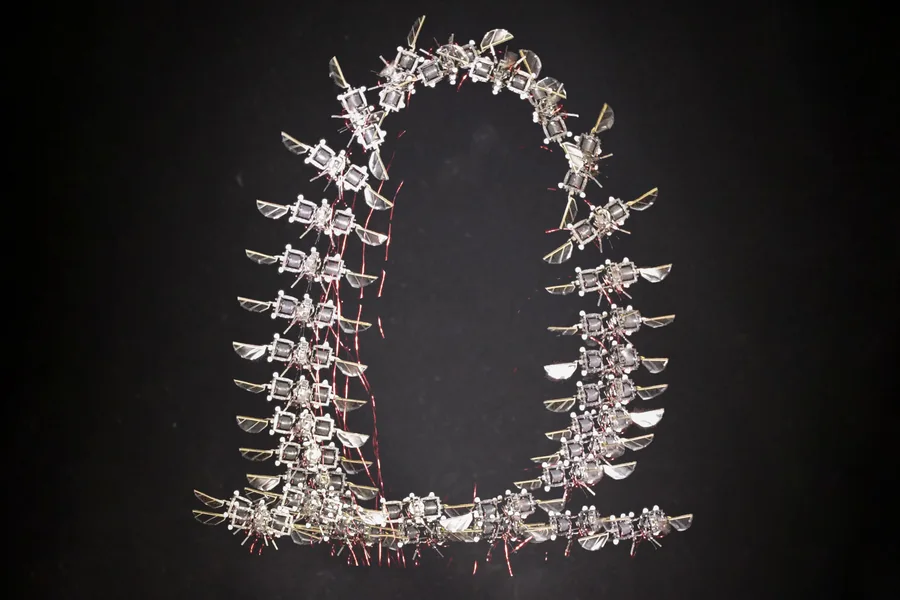
The fundamental challenge of controlling autonomous microrobots down to the sub-gram scale lies in the paradox of both needing fast millisecond-level responses to stabilize against aerodynamic turbulence and limiting payload to avoid heavy onboard compute chips.
MIT researchers have engineered a two-step approach that combines physics-based optimization with deep learning compression to make sub-gram aerial drones faster by around 450 percent and more agile like insects.
1. Challenges of Insect-Scale Drones' Two-Step Control
Flying microrobotic systems at the scale of insects face a set of particularly challenging constraints stemming from:
Fastest Flapping Motions: Driven by hundreds-of-Hz actuation rate of multi-layered dielectric elastomer actuators (DEAs), sub-gram microrobots exhibit fundamentally unstable aerodynamic dynamics.
Onboard Computational Limitations: Conventional high-performance motion planning and control approaches (e.g., Model Predictive Control) involve evaluating thousands of candidate trajectories per second, making them too heavy for sub-gram payloads.
Legacy Controllers' Limitations: Simplified PID-based approaches offer less performant response and cannot safely execute complex, high-speed acrobatic maneuvers only achievable at a fraction of a meter per second.
2. Platform Architecture: From Two-Step Control to Policy Compression
By breaking the motion control problem into two separate stages, the MIT team has designed a two-step policy that enables rapid, agile flight at a fraction of a watt:
Algorithm 1 (Offline Planning): Given a set of possible state-trajectory pairs, the model predictive control (MPC) planning algorithm iteratively converges on an optimal trajectory given full dynamics of a flapping-wing microrobot.
Algorithm 2 (Policy Compression): By applying imitation learning, the researchers encode the complex MPC planning function as a computationally efficient neural network.
Fast, Lightweight Execution: The compressed student neural network can evaluate optical flow observations and output control signals in less than a millisecond.
3. Flight Performance Gains and Acrobatic Capabilities
The two-step policy demonstrated significant gains in terms of speed, precision, and acrobatic capabilities during a series of lab tests:
Speed Improvements: Top forward flight speeds increased by 447 percent compared to legacy approaches, reaching up to 2 m/s while still maintaining precision tracking.
Agile Trajectory Following: The drone was able to perform a continuous 10-somersaults acrobatic maneuver within 11 seconds while demonstrating stable tracking performance within a tight 4–5 cm envelope.
Adaptation to Manufacturing Variability: The neural network policy demonstrated improved robustness to actuator aging and manufacturing variability at critical regions such as the soft dielectric elastomer.
4. Microrobotics Applications and Future Developments
Beyond the demonstrator application, such bio-inspired control solutions enable further applications of small-scale drones in confined environments:
Search-and-Rescue Applications: Sub-gram drones are ideal for exploring collapsed structures and other hard-to-reach areas that larger rotorcraft drones cannot access.
Environmental Monitoring: Swarms of such microrobots can be useful for gathering environmental intelligence in vegetated areas that large multirotor drones cannot navigate safely.
Transition to Onboard Sensors: Researchers plan to transition from using external motion capture position estimation to developing onboard optical flow and miniature sensors to enable free-flight operations in unconstrained environments.
Sources
- Zewe, A. (2025, December 3). A time-lapse composite image showing a sub-gram flapping-wing microrobot performing a continuous sequence of acrobatic flips in flight [Photograph]. MIT News. https://news.mit.edu/2025/mit-engineers-design-aerial-microrobot-fly-like-bumblebee-1203