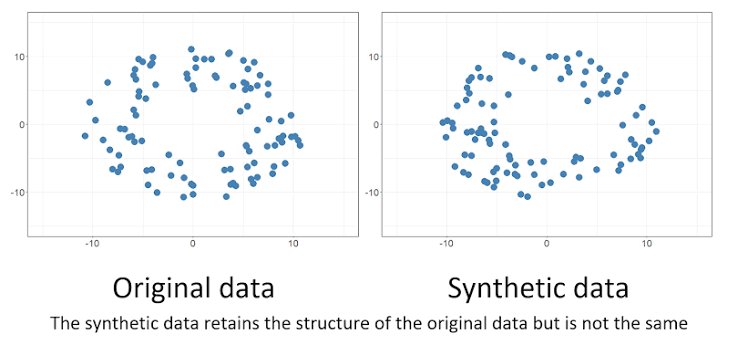
Developers require data to test out their software and design artificial intelligence systems, but actual records have the potential to give away private information. Synthetic data can generate artificial records with patterns similar to an existing set of information at a given time, which brings up the question of how can invented information be helpful.
Synthetic Data Summary
Synthetic data, according to NIST, is created instead of collecting samples from actual subjects. One method proposed by NIST is to make a statistical model that contains a set of people that represents the target population, but the new records will be about fictitious individuals. An example given is sets of numbers that make up a list of customers and the purchases they have made, which can be used to test out a shopping app.
The artificial records that are generated still need to serve a purpose, and one way to determine if it is suitable is to see if it has the right properties like if it was meant to test out a date validation application or to check if there are any relationship between spending and demographics. These two options have different requirements, so it has to be built around it.
One thing that the National Institute of Standards and Technology (NIST) warns about is that accuracy is challenging to measure when it comes to creating records of individuals with formal privacy methods. The ability to maintain useful relationships within the data is difficult to achieve.
The conclusion that can be drawn is that researchers and developers need to think about what properties would they want the data to have in order to accomplish its' goal. It would be best to prioritize what needs to be achieved over making the records appear realistic if the necessary tools are not available.
Something that NIST has warned about is the fact that many approaches mentioned do not inherently offer formal privacy guarantees. Just because information is man-made does not mean that its secrets are unattainable. Organizations need to be aware of both the privacy and usefulness of the records if they decide to use it.