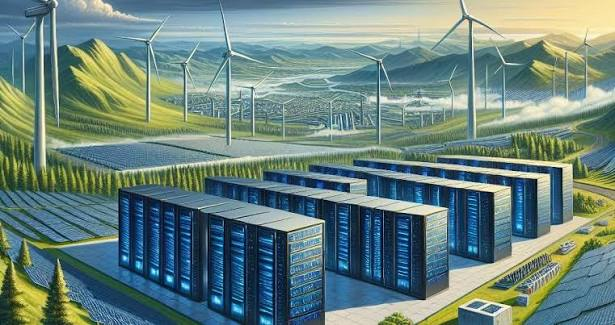
When one asks a question to an AI chatbot, the response is visible on the screen after only a few seconds. It is easy to forget that the result is the work of computers that require electricity to function. With the rise of artificial intelligence, the supporting structures have become an increasingly significant aspect of consideration.
The Source of the Power Behind AI
Data centers are facilities where computers are kept to process and store information. They provide the infrastructure for many digital services, including AI systems. According to the International Energy Agency (IEA), they are considered essential to both the training of AI models and their use following their creation.
The two functions have different implications. The former refers to teaching the models to perform specific functions, while the latter is their application in practice. By thinking about both, one can better understand the importance of the electricity consumption associated with such facilities.
The crucial point is that they also support operations that have nothing to do with artificial intelligence. Therefore, the total electricity consumption should not be considered as related to AI exclusively.
How Rapid Is the Growth of Demand?
IEA reports that the electricity consumption of such data centers rose by 17 percent in 2025 on a global scale. At the same time, the electricity consumption of AI-oriented facilities rose by a stunning 50 percent during the same period. It means that the infrastructure for such projects has a significant environmental impact.
In its 2025 Energy and AI report, the IEA forecasts electricity use for data centers to grow to 945 terawatt-hours worldwide by 2030 under its base-case scenario. It would constitute close to 3 percent of global electricity consumption. However, it should be remembered that this is a scenario that may or may not come true depending on multiple factors.
Reducing the Environmental Impact of AI
The information above raises several critical questions, the simplest of which is about how to achieve the proliferation of AI without electricity consumption. One way to achieve this goal is to examine what activities actually require intense computation.
It is clear that a request for information and a complex AI-driven project will have dramatically different demands for electricity. According to the IEA, if all conventional internet searches were replaced with simple text requests to AI, this would add up to less than 4 terawatt-hours of electricity consumption per year.
This estimate demonstrates that the impact of AI on electricity consumption depends primarily on the volume and complexity of tasks given to it. It also demonstrates that a single number that represents the impact of AI is insufficient because it fails to consider the context in which it is used. When comparing different metrics, it is necessary to highlight whether they relate to AI exclusively or to the entire data center industry as a whole.
Summary
Artificial intelligence has a future that is inextricably linked with its physical infrastructure. The growing electricity demand is the source of doubts about the sustainability of such a path. Considering the topic is essential to understanding how appropriate this technology is and its role in the future.
Ultimately, the two dimensions of analysis, namely the contribution to human activity and electricity consumption, are critical to examining the technology in detail.
References
International Energy Agency. “Executive Summary: Key Questions on Energy and AI.” 2026 .
International Energy Agency. “Energy Demand from AI.” Energy and AI , 2025.