Ultra-Wideband Ranging: Measuring Where a Device Is Nearby
Knowing that a device is connected does not tell us precisely where it is. Ultra-wideband, or UWB, can supply another kind of information: distance and position derived from radio measurements. That capability can make a device aware of its spatial relationship to other equipment, which is useful when a system must respond to location rather than simple presence.
Timing the Radio Journey
NXP's introduction to UWB discusses bandwidth, signal propagation, time of flight, and angle-of-arrival measurements. These characteristics support ranging and localization. Time of flight concerns how long a signal takes to travel between devices, providing a basis for estimating distance.
Qorvo's white paper about UWB in factories describes two-way ranging and other arrangements. In a two-way exchange, devices send timing messages that help separate the signal's travel time from the delay involved in replying. Multiple fixed reference devices, often called anchors, can support a position estimate.
Imagine a workshop locating a cart that carries important tools. A report that the cart is somewhere in the building is different from a useful estimate of its position. In this hypothetical application, the distinction determines how much searching a worker still has to do.
Distance and Position Are Different Results
One distance measurement describes separation from a reference device. Locating something within a space generally requires additional measurements or information. Qorvo describes different infrastructure and ranging arrangements depending on whether location is calculated in a tag or in a central system.
The choice affects the complete application. A cart displaying its own guidance and a central map showing several carts need different information flows. The radio technology can support measurements, while the system designer must determine where the result is calculated and how people receive it.
NXP describes UWB as adding spatial context to wireless devices. A useful interpretation of that phrase is that position becomes another input to the device's behavior, rather than a replacement for every other input it needs.
Testing the Intended Space
For the workshop, the appropriate evaluation would take place around the rooms, equipment, and routes workers actually use. A claim about a technology's potential accuracy is different from demonstrated performance in that setting.
The map should also communicate whether a position is current and sufficiently dependable for its purpose. Finding a cart and guiding a precise physical operation would require different levels of confidence. That judgment belongs in the application’s design.
Summary
UWB ranging turns carefully measured radio exchanges into information about distance and position. Its usefulness depends on reference equipment, calculation methods, and the spatial task being supported. A successful deployment connects its measurements to a clear location result that users can interpret in the environment where they work.
Works Cited
NXP Semiconductors. “Understanding UWB Technology: What It Is and How It Works.” n.d. Accessed 10 Oct. 2026.
Qorvo. “Ultra-Wideband Enables Smart Factory of the Future.” Aug. 2022. Accessed 10 Oct. 2026.
Swisshashtag. “Apple AirTags einrichten.” Wikimedia Commons, 22 April 2021. Image. CC BY-SA 4.0. Accessed 10 Oct. 2026.
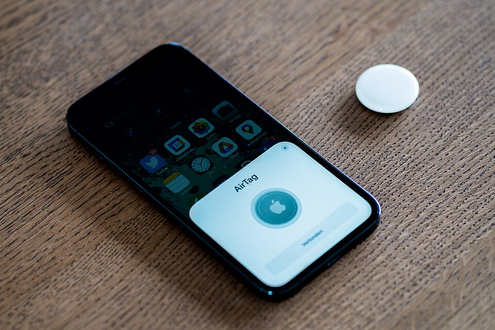
An Apple AirTag being set up with an iPhone. Image: Swisshashtag; CC BY-SA 4.0.